

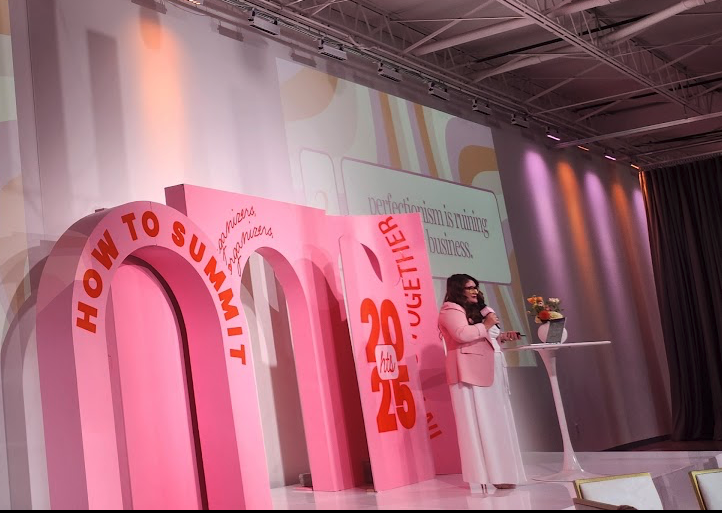
230 | 7 Things I've Learned (How To Summit MainStage presentation P2)
Make it stand out
Whatever it is, the way you tell your story online can make all the difference.
This one is better with video…here you go!
You can listen right here by pressing play, or you can read the full transcript below!
LINKS FOR LISTENERS
Connect with Melissa and Pro Organizer Studio: CLICK HERE
If you are interested in our Inspired Organizer® program, you can find us at www.inspiredorganizer.com
We have a whole library of podcasts here, our YouTube channel, and you can find us on Facebook and Instagram at Pro Organizer Studio.
FULL TRANSCRIPT
Melissa:
Hey, pro organizers. It’s Melissa, and I am back with the second part of my onstage—mainstage, I should say—mainstage presentation at the How To Summit in Dallas last week.
You guys, it’s my third podcast this week, so I would like some sort of praise. Some sort of validation. And you’re like, “No, I’m not going to give you any, Melissa, because you haven’t given me a podcast for a while.”
So keep going. I promise I’m going to keep going. You probably aren’t going to get three next week, but you’re going to get some good stuff next week.
So at the end, I do have a little piece of information about our Inspired Organizer program, which is opening for two weeks before we make massive changes. Very big changes, including price and some other things.
I would love for you to join us. We are doing a guided—coached by myself and Cabri—a guided, coached run-through of the entire program. So if you need active coaching, if you need to know how to really make sure that your business—no matter where you are in your business, whether it’s 20 minutes or 20 years in—there are always things we could be doing in our business.
Let us help you make sure that you are going into 2026 with a completely refreshed, ready-to-go business.
So if you want information: hello@proorganizerstudio.com, or reach out to me in many of the other ways you can find me. But I have more information at the end.
Okay, here we are with the second part.
If you haven’t listened to the first part, please go back—just one podcast episode.
Before I forget: if you would like to follow along either just with the slides or with my voice-over the video, please go to proorganizerstudio.com/links and you can follow along on the slides that I am talking about during this podcast.
But where we left off, I had just wrapped up with the third one, which is about your digital foundation. And I’m going to roll into the fourth bullet point, which is one of my favorite things to talk about. So I would love for you to listen.
I hope that you are having a great day, and here we go.
Nothing in our business is possible without clients. And the easiest way to get clients is that solid digital foundation that I talked about on the last podcast.
Now let’s talk about something that I’m gonna say that is probably not a surprise, but is still pretty controversial.
If your main goal is in-home, local organizing jobs, number four thing that I have learned out of the seven big things that I’ve learned is that you are way too worried about your social media.
I want you to do an honest assessment of your social media. Look at your account and scroll through your followers. How many of your followers are in our industry? My guess is: a lot. I have hundreds in my Home By Eleven social media.
Now, I would like to say: followers in our industry are lovely, wonderful people, and it is absolutely not that you don’t want other organizers to follow you.
It’s just that when you look through your following and you realize this vanity metric that you have of number of social media followers— a lot of those people are in our own industry. They are not potential clients, they are not going to bring you potential clients, and they are not people that you’re actually trying to reach with your messaging.
I also—if you’ve been in business for a while—want you to have an honest assessment of how many paying clients have discovered you that way. How many people have reached out on Instagram DM and said, “Hey, I’d like to book a session with you. How do I do that?”
And I’m not talking about people who might have said, “Oh, I saw you on Instagram,” or “I followed you on Instagram,” because they actually found you on Google and then went to go see your Instagram. How many people have actually come to you solely because they were introduced to you because of Instagram?
All right. Hopefully you’re following along and you can see this on the slide, but in case you can’t, I am giving you a little visual of my own Home By Eleven social media.
I have a profile pic from 2018. It’s not even my current hair color. My hair is about— I don’t know—probably a foot shorter. And it was a selfie.
Then I have 2,954 followers, which—for Brandi and Ryan, who hosted the How To Summit—it’s a rounding error on their audience. Okay? It’s literally 1% of their audience.
So I do not have a lot of followers.
On my grid—my first grid of six—I didn’t even do a grid of nine, grid of six—two of my six are from December of 2024.
I don’t know if you’re aware of this, but it is currently, as I’m talking to you, October of 2025, which means these posts are almost a year old and they’re still on my top six.
This year so far, in 2025, I have four—as I titled them—extremely lazy and not well thought-out posts in 2025. Okay?
So I do not believe that using social media is important. And here are just some results for you:
I am an organizer part-time. I am solo by choice. I do not have assistants. I do not have anyone that works with me. I do all my work myself. Like I said, organizing is my side hustle.
I have not taken clients since July, with one exception—I actually was at a client last night, but that’s another story.
And I have brought in $41,162.95 this year—side hustle, very part-time—and only through the first six months of the year.
So that is with four social media posts. I’ve done absolutely nothing on my social media of note, and I still have plenty of clients and still have plenty of people asking for me to come to their house.
I want to talk about things that belong to you.
Things that belong to you and your business are your website and the work that you do on your website. Your email list belongs to you. Those are people that have come to you, that you have cultivated, that you have found. So that email list and your customer list—that is another thing that belongs to you.
Those are people that have found you, booked with you, done a consultation with you, inquired with you. Your customer lists are things that belong to you.
I’m going to tell you what doesn’t belong to you: things that belong to other people, and that other people control and own.
Instagram. Facebook. Anything from Meta. They own that. TikTok. Don’t even know who owns TikTok these days. I think it’s all for sale. I think—I don’t know. Anyway, it doesn’t matter.
Algorithms—you cannot control an algorithm. And by the way, when people talk about, “I know the algorithm.” No, they don’t. Nobody knows the algorithm. And by the way, it changes all the time. It changes all the time.
Remember when I first started my organizing business? That was back when Instagram—you had to have a perfectly curated grid and it had to be perfect, and you had to have a structure. Now, pretty much anything goes, right?
Now you need to do reels, but the reels generally tend to need to be funny or really well produced.
And it started out as reels were 10 seconds and 30 seconds and 90 seconds. Now I think you can do three minutes, five minutes, ten minutes. I don’t even know what it is anymore.
And do you know why I don’t know what it is anymore? Because it changes all the time.
Okay. We do not control and own that. Instagram does.
And by the way, let’s say you get really good at reels. Maybe they come up with something new tomorrow and they decide, “Eh, just kidding. Now I need you to do this other thing.”
They are constantly developing new things and keeping you on the hamster wheel because they want to keep you using their product.
Okay. Meta, TikTok—all of those social media—they own your users and followers. You don’t.
I actually read an article that Mark Zuckerberg of Facebook toyed with the idea of setting everyone’s friends back to zero and making you start over again. He could do that. They could do that on Instagram.
Things happen all the time. People’s accounts get hacked. Lots of things can happen, and they are very much out of your control.
That’s all.
Here’s what I want to say about social media:
If you love it, and you really thrive on it, and you’re like, “This is fun, I love making reels, I love doing it, I enjoy interacting with other people even if I’m never going to get an ounce of business from them,” totally fine. Please go forth. Do social media. Enjoy it.
Also: do social media, but keep it fun. It shouldn’t be work.
If you dread doing social media—like so many of the people that come to me and they go, “Oh, I really want to start an organizing business, but I don’t want to do social media”—you don’t have to.
If you dread it like I dread emptying the dishwasher (it’s my most hated household task), please stop devoting your time and energy to it.
If you do not enjoy doing social media and you are spending more than 10 minutes a week on it, re-evaluate. Okay? You absolutely do not need it.
Now, if you are sitting here saying, “Melissa, you’re completely insane and I’m absolutely not doing that. That is the dumbest advice I’ve ever heard in my entire life,” totally get it. You do not have to listen to me.
But what I do want to encourage you to do is: at the very least, please go recycle your content. Instead of making brand new content, I guarantee you have hundreds of posts that you can just recycle.
Here’s a little hint: in a lot of cases, only about 10% of your audience even sees what you post.
And then I have some other news for you, which is even if they saw it the first time, I guarantee they have forgotten about it—unless it is insanely memorable, and even then.
So go recycle that content instead of making something brand new. Save yourself some time and energy.
All right.
The fifth thing that I have learned that I want to talk to you about is: you’re comparing yourself to others with no data on how they are actually doing.
Comparisonitis is something that is really active. I have spoken to some of the most wonderful people who are in professional organizing, and they are down on themselves because they say, “Ugh, I saw XYZ. She’s doing ABC.”
You do not know—especially from one social media post, or multiple social media posts even—you do not actually know what’s going on behind the scenes of that picture, of that moment.
If you’re saying, “Wow, she’s in houses all the time,” how do you know that content wasn’t made months or years ago? You don’t know that it happened yesterday. You’re assuming.
We make assumptions by what we see. Guess what? Social media is absolutely just presenting one single solitary moment in time. It does not show you everything behind the scenes.
I personally know people who project an image on social media that could not be possibly different when the camera goes off at the end of the day.
I know people who are exaggerating what they do, where they go, who they organize for, what they’re getting paid—all of that.
I want you to stop comparing yourself to someone else when you do not know their entire story.
I’m here to tell you that some of the quietest people in our industry are the ones that are actually doing the best.
And when I say “actually doing the best,” I mean: have thriving businesses that are meeting their goals and in a lot of cases making a lot of money. They’re the quietest ones—the ones that you would least expect.
The loudest ones often don’t have everything together. Like you and me.
Imagine that they do, okay?
Think about your own social media feed, or your own whatever you project out into the world.
Think about a time that you have—say you go to a client’s house and you are having a terrible day. Terrible. And they open the door and you walk in, and they say, “Oh, how are you?” And you’re like, “Oh my gosh, I’m great. Thank you so much. How are you today? I’m so excited to work on your house.”
Are you really great? Of course you’re not. Okay?
Are you projecting an image that you’re great? A hundred percent. Throw a picture on that and throw it on Instagram and that’s what you’ve got.
Stop comparing yourself to others.
By the way, this is not just about social media. This could just be about, “Oh, I got together with some other organizers and wow, I’m really envious because she did XYZ thing.”
The other thing I want you to know about comparing yourself against other people in business, and comparing success, and comparing anything really—it could be even comparing your rates, it could be comparing how many hours you work, anything like that—you also do not know what kind of support someone does or does not have.
There are people who are entrepreneurs in many businesses that have wildly different needs or goals or financial metrics than you do.
I know organizers who are very fortunate and they do not have to work. They just choose to work because they enjoy it, but they do not have the pressure on them for financial success that someone—for whom this is their full-time job and they’re a single mom—which is also many people I know in the organizing industry.
Stop comparing yourself against someone else’s business when you also don’t know: what support do they have? Whether it’s financially, personally, professionally, mentor-wise—anything else. There are a lot of things happening that you might not know about.
Okay.
The number six thing that I’ve learned: you need to understand ADHD and neurodivergence. And then I want you to talk about it on your website.
Adult women account for 44% of all ADHD diagnoses. And if you’re following along on the slides, there’s a picture of me wearing a unicorn headband, and I just say: millions more women are undiagnosed. And I am absolutely one of them. I am absolutely 100% positive that I have ADHD.
And I think I said on the last podcast: anyone who’s listened to this podcast for a long time could probably have figured that out.
But there are millions and millions of women out there who are finding out that the things that they have struggled with for a long time have a name—or have a diagnosis—and sometimes have a treatment plan, okay?
But sometimes the treatment plan is learning how to cope and learning how to understand how their brains work, and then fixing things that go with that. And that includes their houses.
So these women—these 44% of women—need organizers to help them.
They are super open in discussing their diagnosis. I know as organizers, people tell us a lot of things sometimes that we absolutely do not need to know, but ADHD and neurodivergent people are generally very happy to tell you, “Hey, this is my diagnosis. I have ADHD. I’m trying to figure that out.”
And the most important thing that you need to know, if you are not as familiar with ADHD or any other neurodivergence: people who have this diagnosis are not one-size-fits-all.
I have been asked so many times, I cannot even count. Someone will come into our group and they’ll say, “Oh my gosh, I just had a client who told me that she’s ADHD. How do I organize with her?”
Every single person who has ADHD—it manifests wildly differently.
I had a client whose ADHD manifested actually more like OCD, but her ADHD—in order to accommodate it—she had to have a level of organization that was actually so intense. That’s how she had to manage it. Every single thing had to be in a specific place, otherwise she couldn’t function.
I have had other people that are in the more what we would term stereotypical or traditional presentations where you are trying to go through their shirts and they’re like, “Oh my gosh, I forgot about the seven CDs I have from college that are in the basement closet. I need to go get those right now.”
You’re like, “Nope. We’re actually focusing on one thing right here.” Okay?
And it’s everyone in between, right? There is not a one-size-fits-all.
What these women and their families need—because a lot of times other people in their family also have a diagnosis—they need systems. They need easy-to-understand systems. They need understanding. They need a nonjudgmental space. And they need support in maintenance.
A lot of these women struggle with maintenance, and that is a great way to be able to help them and to be able to create revenue for your business.
The best book that I can recommend for this to get you started on this journey of learning is called Organizing Solutions for People with ADHD. It’s by a woman named Susan Pinsky.
I have recommended this book 800,000 trillion times. A lot of people in Inspired Organizer have read it and have absolutely loved it like I have.
I also do have a podcast episode—184—called Getting ADH Curious with my friend Missy McKown, who has ADHD and heavily promotes on her website that she works with people with ADHD, autism, and other neurodivergence.
And it is just—it’s a service that she offers that she really believes in, and it helps a lot of people and also creates a lot of business for her. So really recommend it.
What I want you to know about ADHD and neurodivergences: not only are you going to help people, you are going to create a lot of revenue for your business.
And if you successfully learn how to navigate some of these different presentations of ADHD and help these women and their families, you are going to be referred time and time again.
But at the end of the day, I need you to understand it, figure out how to work with people.
And I do understand: a lot of organizers—it’s not me—but a lot of organizers come from a background where they’ve been organized their entire life. They can’t imagine not being organized. They can’t imagine how someone’s brain could not work in a linear fashion.
So please—I just ask you—if you are more on that side, open up your mind and just understand that people’s brains work wildly different ways.
And we’re finding out now that there’s been a long time that we have treated everyone the same—and that’s not realistic.
So go out and get those clients, learn a lot, help them, and make a lot of money.
All right. My last thing that I have learned is that you need people who get it—who get our job, who get being an entrepreneur, who get being an organizer.
Find a community of people.
You need someone who will be appropriately outraged that your client did it—fill in the blank—today without having to explain it.
So for instance, you just need to be able to go to someone without any explanation and be like, “Do you know what my client Julie did today? She took that entire cabinet—remember the one that I took four hours to put back together last time?—and she took everything out of it and rearranged it and she doesn’t like it.”
Yeah. Yeah! I know!
Okay—whomever you go home to, whether it’s a spouse, a dog, a cat, your kids, or even just—I talk to myself a lot—you don’t want to have to explain the story. You just want someone to be like, “Oh my gosh. You think that’s bad? Guess what Judy did today? Took out her six horses’ ashes and wanted me to rearrange them on the mantel and then organize all of her paperwork in three hours.”
Yeah. Whatever it is.
Did I just pull those examples out of my who-knows-where? Absolutely. See? ADHD.
But find your people that understand what you are going through.
I want you to find a community. I want you to reach out to people.
By the way, I know it’s hard sometimes to put yourself out there and be like, “Hey, I need a buddy. I need a friend.” But I’m guessing that if you reach out to someone, they’re looking for that too.
The Summit was a great place for people to get together and meet. If you are listening to this and weren’t able to get to the Summit this year, reach out to people in your own community.
By the way, a lot of organizers—it’s not everyone, but it’s almost every single person I’ve ever met in organizing—really is a believer in collaboration over competition.
So even if someone is a theoretical competitor in your area, you might end up becoming really good friends with them, and they are your person that you really get.
I have a couple pictures that I showed on the screen. One of them is my three Minneapolis organizing besties. The four of us get together once a month. We try to just talk about family and business and organizing and clients and all sorts of things.
Technically, yeah—we are all competitors. And every once in a while, we’ll send a text going, “Hey, did so-and-so contact you?” That happens actually a decent amount.
We’re competitors, but we give each other business all the time.
And in fact, I found out that I accidentally gave away a Minnesota Viking to one of my Minneapolis organizing sisters. I couldn’t do the job, and the woman did not tell me who she was. So anyway—Cori and her team did a great job there. And my husband wanted to kill me. He was like, “You gave— you what? You had a chance to go to whose house and you gave it to Cori?”
So anyway—but these ladies are… it’s so wonderful to be able to have a group with them. We text almost every single day, if not many times a day, talking about what’s going on in our businesses.
And then the other picture is—I, of course, as I’ve already said, got to go to Japan last year.
And my friend Michael is in this picture, and he is a very dear friend of mine. Yes, he’s a man who organizes. He is a unicorn, ladies and gentlemen.
But Michael and I had such a great time in Japan with so many other organizers, but he is someone also that I can go to and talk about what is happening in my business and all sorts of things.
I have tons of other people. I could have put a hundred pictures on the screen.
I’m so lucky to be able to have so many people in the organizing industry that are part of my community—my Inspired Organizer community. We have such a lovely, wonderful, supportive group of people.
And I just want you to be able to find those people, too. And if you need a community, I can help you with that too.
So to close up: the main thing I have learned is this is truly an amazing industry.
Absolutely, completely, truly—the people that were in the room at the How To Summit, the people who are listening to this in your car on the way to a client, the people who are just out there trying to decide whether this is the industry they want to be in, whether this is a leap they want to make—it is truly an amazing industry, and I am so excited to be a part of it.
So that was my mainstage presentation at the How To Summit—those seven things that I have learned are truly… those are the core things.
By the way, I could have given you 10 things or 15 things or 20 things, but I really wanted to keep it to the ones that I truly believe. These are the “I’ll die on that hill” ones, right?
I had such a great time talking to that crowd.
If you were there, if you came up to me, if you said something to me, if we took a picture together, if you gave me a great big hug—I’m so grateful to the people that listen to me, and I am so grateful that I am able to help serve this community.
If I can help serve you back, we are doing something right now in our Inspired Organizer group. It is called Boss October.
And we are going through—it’s a live-coached version of our program. So we’re going to teach you everything from start to finish to get you ready for the rest of this year and for 2026.
We are opening the Inspired Organizer program for two weeks. So two weeks from today—on October 16th—Inspired Organizer will close, and I am going to be doing some major changes, which I will tell you about.
I have lots of ideas and lots of things that I’m working on, but this will be the last time that you can get in. This will be the last time that you can get in before we make major changes and price changes and all sorts of things.
And then you get your own guided Boss October group.
And I am hoping that these words have helped you this week.
Listen, you guys—you got three podcasts this week. Three podcasts.
So I hope that was great for you. I hope that you got something out of it, and I’ll see you next week.
Bye, organizers!
CONNECT WITH PRO ORGANIZER STUDIO
We’d love to work with you. Send us an email (Melissa answers them personally!) or connect with us HERE…or check out our programs HERE.
If you’d like to watch our FREE seminar, The Pro Organizer’s Profit Plan—check it out here!