

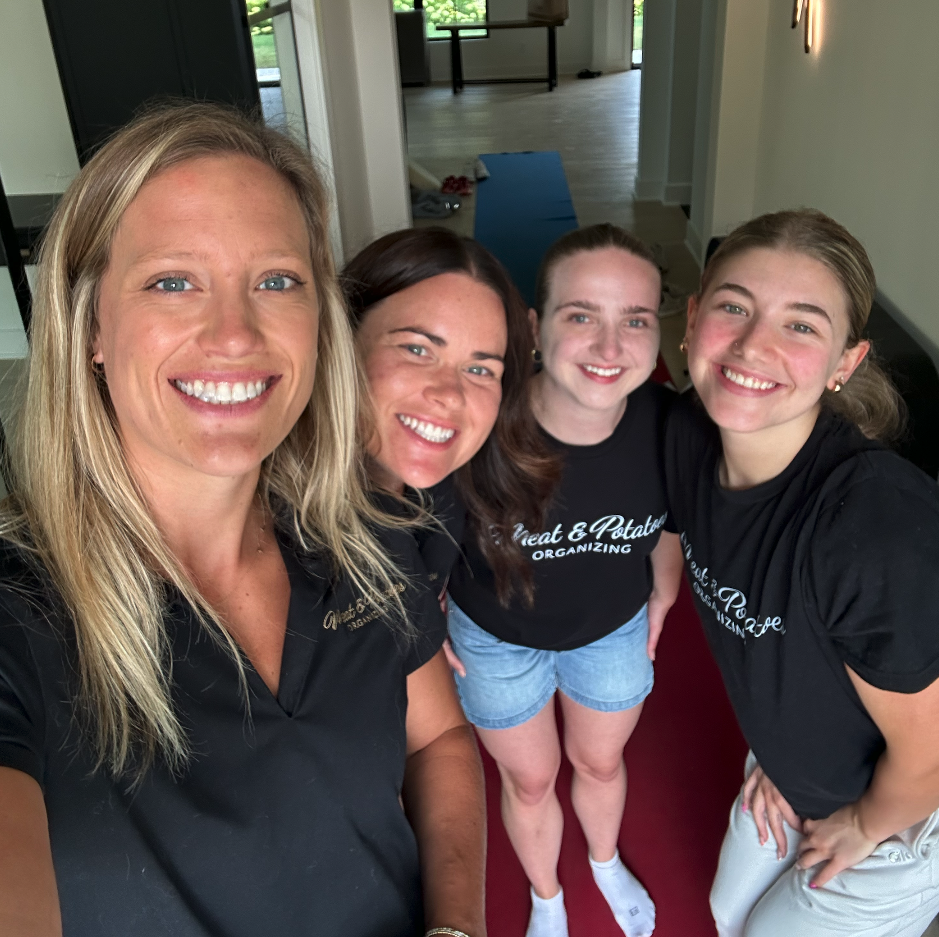
“Hey, would Emma like to be an organizer for the summer?”
That was the text that started an awesome summer for my college kid, working for my friend Cori McDougald at Meat & Potatoes Organizing in Minneapolis.
We got together to talk about it—the good, the bad, and the dirty garages of it all!!!!
You can listen right here by pressing play, or you can read the full transcript below!
Prefer seeing us chat live? Here’s a video!
LINKS FOR LISTENERS
Connect with Melissa and Pro Organizer Studio: CLICK HERE
Check out proorganizerstudio.com/links for some 10th anniversary events for our programs!
We have a whole library of podcasts here, our YouTube channel, and you can find us on Facebook and Instagram at Pro Organizer Studio.
FULL TRANSCRIPT
Melissa Klug: Hey, pro organizers, it's Melissa, and I'm back with a very special edition of the podcast, and I can't wait for you to hear it. But I did want to start out really quickly by letting you know I am recording this on Sunday, August 23rd. The end of summer's coming — maybe that's depressing for some of you. For people like me who are obsessed with fall, I'm very excited. I'm ready to stop sweating and ready to start putting on some sweaters.
But summer coming to an end also means that I always look at Labor Day as kind of a second New Year's Day — I've talked about this lots of times. And when you start heading into the fall, maybe the kids are back in school. I have dropped both of my daughters back at college, and it really makes people go, "Hey, it's time for me to buckle down and really start heading into that important fall season." Lots of people love to organize when kids go back to school, and it helps you prepare even better for the new year, which will be here before we know it.
So we are doing something we have never ever done at Pro Organizer Studio. It's our 10th anniversary this year, and in honor of that, we're doing some really cool things with some of our programs. We're upgrading some of our programs and our communities, which is really the best part of being involved with Pro Organizer Studio, and I want you guys to be a part of that. Go to proorganizerstudio.com/links, because we are going to be doing some special offers and sales on our programs, which we never ever do, and I want you to be able to get in.
Everything in life is really expensive right now, and I very much understand that — two kids in college, I very much get that. The other day I was grocery shopping, and I was like, "When did Diet Coke become $9 for a 12-pack? Come on, guys, this is ridiculous." So everything in life is really expensive right now, and what I want to do is make sure your business is as healthy as possible, so that you can have a cushion, you can have that comfort, you can really thrive, make sure you're paying your team members well — all of those things. We want to give you some special offers that are going to help you build your business, get a great community of organizers next to you, and really just get involved with some of the wonderful things we have going on. So please go to proorganizerstudio.com/links for all of the good stuff, or you can email me at hello@proorganizerstudio.com, and I would love to chat with you.
All right, let's get started with my very, very special guest, who happens to be someone I've known for her entire life.
Melissa Klug: All right, this is a very special edition of the Pro Organizer Studio podcast. If you are watching this on YouTube, you will see that the person next to me looks very familiar — she looks like I've cut and pasted myself, which I did. My daughter Emma is joining us today, along with my dear friend Cori from Meat and Potatoes, who's been on the podcast many times before.
I also just want to say Emma is going to make another family member very jealous today, because I have always told my husband he can come on the podcast one day, and he is apparently a little salty that you're here today. Is that fair, Emma?
Emma: Yeah, that's the rumor.
Melissa Klug: Yeah, so he's salty that you get on the podcast before him. But I just want to say — Cori and I are big fans of a different podcast, called the New Heights Podcast, and Jason Kelce on that podcast has an amazing way of introducing guests. I told Cori she could just absolutely take it away. So, Cori, would you like to introduce our guest today?
Cori McDougald: I would absolutely love that. I'm gonna take it away — I'm fully caffeinated, so here we go. I hope you guys are ready for the introduction. From the University of Iowa Hawkeyes, we have the lovely Emma Klug. But I'm not done introducing yet, folks, because here's the thing: we have Emma, who's joining us, and her mother — if you didn't know — literally represents the best of what we do in our industry. And I'm not just talking about professional organizing skills. This is a family legacy. They've got work ethic and genuine heart all rolled into it, and mentoring you all along the way.
So if you've been listening to Melissa's podcast for any amount of time, you know exactly who Melissa Klug is. She's the founder of Home By Eleven. She's a master certified professional organizer. She's one of only three people in the entire state of Minnesota certified by the KonMari method. Basically, she's an absolute legend in this space — and here's the best part: Emma is her daughter.
Melissa Klug: She sure is.
Cori McDougald: So this summer, instead of just sitting around doing nothing, Emma decided to come work with us at Meat and Potatoes Organizing as an assistant organizer, and I could not be more thrilled. She came in ready to work. From day one, Emma showed up in the perfect combination of organized and efficient, warm and genuinely personable, and she's the kind of quick learner who just gets it. She's been on projects with our team, working with our clients, learning the ins and outs of what we do every single day, and our team absolutely loves and adores her.
Melissa Klug: Aww.
Cori McDougald: What I love most about having Emma here this summer is watching her experience firsthand what it really takes to build a business like ours, or like her mom's. She's not just learning organizing techniques — she's learning about relationships, client care, the hustle, the heart, the dirty, the clean, the luxury, the not-luxury, the cat pee. She's watching how we run our team and how we handle projects, and for a college kid, I think that's some great experience no matter what you do in your future. So I hope she takes all this back to Iowa with her.
And Melissa, having your daughter on the team has been such a gift for all of us, and we are so thankful you shared her with us. Join me in giving the biggest, warmest welcome to someone who's going to be shaping the future of organizing, whether that's here at Home By Eleven with her mom, or anywhere else her journey takes her. Everyone, Emma Klug!
Woo! That was long. Sorry.
Melissa Klug: No, I loved it. It was long, it was sweet. Thank you.
Emma: Yeah.
Melissa Klug: Very kind to both of us. So let me just say — Cori first brought this idea to me. She's like, "Hey, do you think Emma has a summer job yet?" And I said, "No." And I thought, "Oh, maybe Cori wants her to watch the kids occasionally." And she's like, "Well, I'm thinking about asking her if she wants to be an organizer." And I was like, "Oh gosh, I've never really thought about that." And I'll be honest with you — my very first thought was, "I just want to make sure Cori and I are still friends at the end of this."
The only reason is, you know, you're combining business and personal and all the things. And what I love about this is that Emma did this totally on her own. I have not talked to her about one thing, I have not given her any advice, she has just done it on her own, and I think that's awesome. I think it's a real testament to — hey, maybe pick some younger people to be on your team, because it could bring you some new life. So, Emma, tell us a little bit about your experience so far. What has it been like this summer?
Emma: Yeah, so I don't know — I started the week after I got back. I settled in for, I think, five or six days, and then I started that next Monday. I had one day of kind of shadowing on a bigger project, and then the next week I went into a house in Shakopee, and it's been fun doing very different things. I think that's what I like most — we do move-ins, pack-ups, I've done a lot of garages, closets. So yeah, just moving around the house.
Melissa Klug: What's been the most surprising thing to you?
Cori McDougald: You can be honest. I'm an open book — you can say whatever you want to say. I don't think any of our clients are really listening.
Emma: They're not.
Cori McDougald: But the other organizers who are listening are gonna be like, "Oh, yeah, yeah."
Emma: Yeah, I think my favorite is probably packing up and unpacking, because packing up, it's — that's probably my favorite. It was fun just because it felt like you knew what you were doing. Sometimes when you're organizing a space, you kind of get surprised, but when you're packing up, you just throw everything in a box. And unpacking, you get to have a blank canvas to work with.
Cori McDougald: Okay, to be clear — you're not just throwing things in a box.
Melissa Klug: No, I'm not throwing anything in a box. You're actually packing carefully.
Cori McDougald: Yeah, so a few more details on that. Emma came in — we were in the middle of a giant project for a professional athlete. This was her first training day.
Melissa Klug: Welcome to professional organizing on steroids.
Cori McDougald: Thank you. Also, let me just weigh in really quickly before you tell your story — it's not often that someone's first day on an organizing job is a professional athlete's home. That's a special experience.
Emma: Of a team I really cheer for, so I was just walking around, and also trying to stay professional at the same time.
Cori McDougald: And it was absolute, utter chaos that day, and now you handled it so beautifully. We literally had a client coming in on an airplane with four children, the whole house needed to be completely done and perfect as possible. We were literally to the point where we had to put duvet covers on a bedspread, and I was like, "I can't do this right now." I looked at Emma and I was like, "Have you ever done duvet covers?" She's like, "I'm the best at duvet covers."
Emma: I have a trick.
Cori McDougald: So Emma made all the beds, and this is supposed to be her training, right? There were just five of us in complete chaos, trying to finish this by 3:00 so we could get out the door. Their plane was landing at 4:00, they were coming in hot. It was pressure — and yes, we threw Emma into the fire, and she did amazing.
Emma: Yeah, I thought that day, when we were in the basement and you said, "Can you put a duvet cover on?" I was like, "Did my mom tell you about my trick?" I just thought she'd told you about it — I have my little trick for putting a duvet cover on, and I was like, "Perfect."
Melissa Klug: She was made for duvets. She could have a whole business just changing people's duvet covers, and she would make a lot of money.
Emma: I'm trying to decide if I should teach you, or if I should gatekeep my trick.
Melissa Klug: You can't gatekeep. We don't do that at Pro Organizer Studio, and you can't do it either. But I do think it's funny, because your first experience was a professional athlete's house — that's kind of a unique experience — but you've also had regular organizing experiences.
I will tell you, my favorite thing about this summer for myself has been not only that it's really fun to see my daughter working for a good friend of mine and really enjoying it, but it has been extremely entertaining when Emma comes into my office at the end of the day and says, "Mom, this woman told us she was ready to get rid of 50% of her things." And I'm like, "You don't need to finish that sentence, I already know." I go, "She got rid of two things today, didn't she?" She goes, "Yeah, how did you know?" And I'm like, "Oh, sweetie, that's how it works."
Cori McDougald: Well, that's the thing — Emma's getting this experience firsthand, which I think is important, because these are all things you're going to run into. And she got every single little nugget along the way, especially with the garages. And then I think we sent her to a basement next — a basement, very different than a pro athlete's house.
Melissa Klug: Mm-hmm.
Cori McDougald: You know, they're trying to go through everything in this basement, and it's the struggle of them not knowing if they want to get rid of stuff, and then we're trying to make it look pretty. It's a pretty steep learning curve. That's what I always say — we don't do a ton of training, we don't do a ton of shadowing, because honestly, I think you learn best when we just say, "Hey, could you do this?" And then you do it, and you're like, "Oh, that was easy enough, we'll do it again." And then you do it in the next project, and it kind of grows from there. So we like to do more hands-on, throw-you-into-it kind of training.
Melissa Klug: Emma thrived with that, I think — that was great. What would you say was your least favorite part? And you can be honest.
Cori McDougald: You can be honest, 'cause we all have our least favorite parts.
Emma: Yeah, I think it's hard because I would probably say garages and storage areas, just 'cause it's boring and it's really dirty. The first garage I did, I forgot to bring a pair of gloves, and I came home and I was just like—
Melissa Klug: It's gross.
Emma: But there's always fun parts of everything, like the garages — the first day I worked in the toy room, and that was fun, 'cause then you get to kind of reminisce, like, "Dang, these lucky little kids."
Melissa Klug: You did. Okay, so there was a garage — I will say there was a day you came home, and Cori has this shirt that says "Life of a Professional Organizer," it's a play on Taylor Swift's "Life of a Showgirl," super cute shirt — and you came home, and I was like, "You look like Pig Pen from Charlie Brown." She was dirty from head to toe, every part of her was dusty and dirty and gross, and I'm like, "Oh, she's an organizer."
Emma: Yeah, that day was hard, because we were working around a very nice, expensive car that the owner did not want moved out of the garage, so we were just like—
Cori McDougald: Oh, I know that day. Yes.
Emma: Yeah.
Melissa Klug: Well, and then we had to get around it too — I was personally glad nothing happened to that car, because you're working in a garage with a very expensive car, and you're not going to move it. And what if you drop something on it? All that stuff.
Emma: Yeah, I had to move a giant — the client was like, "I want to put the pressure washer in that corner," and I was like, "No, you don't. Please don't do that to me."
Melissa Klug: What surprised you about working with clients? 'Cause you've had direct client contact this time.
Emma: Yeah, well, it sometimes surprises me how little they want to be involved, if that makes sense. They obviously always go through their stuff, but usually they're just like, "Go ahead" — kind of a free-for-all. I feel like if I was doing that, I'd want to be a part of all of it, but yeah.
Melissa Klug: What's the most surprising thing — someone being like, "Yeah, I don't care about this"? Did you have a moment like that, 'cause I have that sometimes too, where I'm like, "Why don't you care about this thing?"
Emma: Yeah, there was a woman who had a fully new Alo workout set — tags still on — and she was just like, "Yeah, you can get rid of it." Stuff like that, or really nice Yeti coolers that people are just like, "Yeah, I'm just not using it."
Cori McDougald: Because now you've seen people's houses, and you've seen — I hate to say it — overconsumption. Does it change your viewpoint on shopping or buying things or purchasing habits?
Emma: Yeah, honestly. But it's hard, 'cause I don't — like, there were a couple clients where she had three of the exact same spatula, and she was like, "I think I'm gonna keep them." And I'm like, "Why? You're only using one at a time."
Cori McDougald: I was having that conversation yesterday, and it blows our minds, because when people have duplicates of all this stuff, you're like, where's the — you know? And that's always the thing — you want them to understand, but at the end of the day, it is their stuff, and we have to adhere to what the client wants. But then they ask, "Well, what's your opinion?" And you're like, "Well, in my opinion, I'd get rid of 50% of this stuff."
Melissa Klug: I had a client one time — we were doing a kitchen, and he was a guy going through a divorce who hadn't cleared out his kitchen in a really long time. I picked something up and I'm like, "What is this?" It was very old-fashioned — an apple corer, like from the 1960s, for making a pie from scratch. He asks me what it is, I tell him, and he goes, "Well, I guess I should keep that." I go, "You didn't even know what it was until 30 seconds ago. Why are you keeping it?" I said, "Do you make a lot of apple pies, Bill?" He goes, "No." I'm like, "Exactly."
Cori McDougald: Yeah, I think one of the major struggles we've had this summer — and Emma, you've probably experienced this — is a super Type A person who cares a lot about the aesthetics but doesn't want to get rid of anything, and also wants to control the entire situation.
Melissa Klug: Oh.
Cori McDougald: And then we can't perform the magic, and that's probably the most frustrating thing — well, I'm not speaking for you, but for me, that's frustrating, and I know it's frustrating for some of our leads too. We had some conversations this summer, because they're like, "We want to show them the magic, and they won't allow it because they won't let go of control."
Emma: Right.
Cori McDougald: And then it's hard, because yes, it might be up to their expectation, and yeah, perhaps we perform to the level they're expecting. But in our heads we're like, "We could make this so much cooler and so much better if you just let us."
Emma: Yeah, there was a kitchen we were doing — an unpack and organize, they were downsizing but hadn't gotten rid of everything. And we were just like, there isn't room, there's nothing we can do, there's not enough space for anything. And they're like, "We don't want anything on the counter." I'm like, "It's literally impossible."
Cori McDougald: Yeah.
Melissa Klug: I think if I had to pick one thing that overarches a lot of organizing, it's a client not understanding — I always tell them, "This is a physics problem." I can't make more space, I can't compress things, I'm not magical like Harry Potter. There's only a certain amount of space and a certain amount of things that fit in it. And people are like, "Well, why can't you just make it work?" I'm like, "'Cause I'm not a magician."
Emma: Also, this is something I decided — I think when people build new houses, the architect or whoever designs the kitchen should have a professional organizer look at it, 'cause I've been in some kitchens where I'm like, who designed this and thought it was a good idea?
Cori McDougald: Yes.
Emma: Right.
Cori McDougald: It could be a $5 million house, a $6 million house — if you're gonna spend that kind of money, let's think about it a little bit. Let's build the house with a little more intention.
Melissa Klug: That's a really good point. There have been a couple times in my business where I've worked with an interior designer or a builder to try to do things, but even then, a lot of times the designer has an idea for the design and doesn't really care about the function — they just want it to look pretty.
Cori McDougald: Right, and we're like, "Well, what are we gonna do with all this stuff?" And then it doesn't look pretty if we've got all the things, you know?
Melissa Klug: I do think that's a good point, because I've also been in kajillion-dollar custom-build houses, and I go, "I don't have a place to put plates." Right? You've got a $60 trillion refrigerator and freezer and all this stuff, but I don't have a place to put forks.
Melissa Klug: So tell me about working with a team too — your coworkers at Meat and Potatoes. You guys all seem to have a lot of fun together, and that's genuine.
Emma: It is, I have so much fun with all the leads. Sometimes we've gotten to the point where something will be happening and we don't have to say anything, we just give each other the look, like, "What is going on?" I remember one day, Cori, I don't even know if you know this — a client asked if I was Melanie's daughter.
Melissa Klug: You're like, "No, I am somebody's daughter."
Emma: I'm someone's daughter, just not hers.
Cori McDougald: The other funny thing is my mom works for me, and she and Emma got along great, because my mom does Olympic weightlifting, still competitively, at the masters level, and Emma did competitive weightlifting through high school, so they bonded over that. My mom's like, "Oh, Emma's just the best, we just get in there and work hard."
Melissa Klug: We love Brenda.
Cori McDougald: Brenda is great.
Emma: I knew your dad before I ever even met you, 'cause the Olympic weightlifting community — like, high school Olympic weightlifting — is very small. Only five high schools did it, so we all kind of knew each other.
Melissa Klug: Did your weightlifting career — this is a serious question, all joking aside, it is a physical job — did you ever have a moment where you were like, "Oh, thank goodness I've really been working out a lot and doing Pilates and all the things"?
Emma: On Tuesday. We were up in a garage that had ceiling storage, so it was a lot of lifting. Happy I learned some good body mechanics.
Cori McDougald: Basically doing a clean and jerk for every tote going up into the ceiling storage — on a ladder, too. So balancing while pushing something over your head.
Melissa Klug: I do think that was one of the most surprising parts to me when I first started organizing — it is a physically hard job, and I think we don't give enough credence to that.
Cori McDougald: Yeah, and here in Minnesota in the summer, it's just humid. So when you're stuck in a dirty garage, drinking the air, sweaty and a mess — I have to say, that is not my favorite kind of organizing. I'm cranky for two days after that, I'm tired, it's not ideal. But the flip side is, well, we're not gonna do it when it's -20 outside, so I guess we just suck it up and do it when it's hot and humid — take breaks, drink electrolytes, pack snacks, bring fans, whatever. But some days you're just like, "What are we doing here?"
Emma: When I drive home from those kind of jobs, I'm just turning the AC up to negative 20.
Cori McDougald: Or when you go into a client's house and they don't believe in air-conditioning, and you're like, "People, I believe in air-conditioning, can we please?"
Melissa Klug: If you're watching this on YouTube, Emma's face just dropped, because one of the best texts I got from her — she sent it to our family group chat, and she's like, "Hey, guys, ask me what temperature the thermostat in this house is set to." It was 78, and it was really hot that day inside that house.
Emma: Yeah.
Cori McDougald: And the funny part is, the next day, the moving company calls me and goes, "Cori, we've got all this person's stuff loaded in the truck, and we're supposed to bring it to the next house, but they don't know if they're gonna close on that house, because they think the AC is broken." And I go—
Melissa Klug: Oh, get out.
Cori McDougald: "The AC's not broken, they just didn't use it." I said, "Turn the freaking thing down, have the inspector look at it." I'm like, they didn't even use the AC — I was like, "Turn it down." And he's like, "I'm just afraid this isn't gonna close, and I've got all these things in there, two trucks full." And I said, "Just calm down, I know the AC wasn't on yesterday." And it was hotter than Hades.
Melissa Klug: Tell me about it.
Cori McDougald: You were unhappy that day. My team was uncomfortable, the five movers were extremely uncomfortable, and everyone was worried the house wasn't gonna close and the deal was gonna fall through, all because of an air conditioner. I'm like, "People, just turn the AC on, let's go."
Melissa Klug: So has it changed your perspective at all — I mean, I know Cori asked you about consumption, but on your own organizing? As you're getting ready to move back to college and you have a roommate, did you learn any fun tricks this summer that you're gonna take with you?
Emma: I think I'm being more mindful with my packing. Last year I just threw everything in bags as I was going. But right now my room is sorted — I have my clothes, my toiletries, it's all pulled out and sorted, so it's just easier for me to move in.
I feel like I'm just gonna be a little more mindful of where my stuff is. Like the first kitchen I did, it was, "You want your cooking utensils closer to the oven." And I was like — it sounds dumb, but I genuinely would not have thought about it like that. You want stuff in proximity.
Melissa Klug: Yeah.
Cori McDougald: And these are things we don't think about on a daily basis unless you're doing it every day. We've done so many kitchens, and we're like, "Oh yep, we'd recommend doing this and this." And then you see, when we have a new organizer or an assistant, their eyes light up like, "Oh, yeah." Emma, you did so great, though.
Melissa Klug: She, I hired her for my own house too — I said, if you're learning all these skills this summer, I have some parts of our own house that need to be zhuzhed a little bit. You've been doing a ton of cooking this summer, so you did a whole kitchen refresh, which was really good. And currently, I was like, "Hey, can I get you to do one more thing before you go back to college?" So you're working on the storage room of doom with some of my stuff. So how is it being with me as a client?
Emma: Wait until you see the basement when you come home.
Melissa Klug: Is it good or bad?
Emma: Well, I don't wanna get rid of your stuff, so it's just all everywhere.
Cori McDougald: Just everywhere.
Melissa Klug: But you've done — I mean, it's been fun to watch you take on a project like that, when the client doesn't really wanna be involved. It's funny, I have been that client for you — I'm just like, "Do what you want, I don't care, I just want it to be better and different, do whatever."
Emma: Yeah, and I've been trying to be my own client too. I was going through my closet, arguing with myself about some shirts — I'm like, "But what if I want to wear it on a night in Iowa City?" And I'm like, "Well, you didn't wear it even one time last year — love it, but I have to fight with myself about it."
Cori McDougald: Having conversations with herself now.
Emma: Yeah, in my own head now — sorry, now I'm gonna be in my head about everything. I'm not gonna bring that hoodie to college, and if I'm not bringing it to college, why do I have it at all?
Melissa Klug: Well, I love this all, and I don't wanna embarrass you, but when we first started — I've told my story a hundred thousand times — our house was always a complete disaster, we were super chaotic. When I read Marie Kondo's book, it really changed how I thought about my house, and I was like, "Okay, I really wanna get my house together," but I didn't force anyone else in the family to do it.
Emma was about 10 or 11 at the time, and your room was really bad — you could break a leg walking into Emma's room. I didn't dictate how rooms were, I was very much, "You can have your room however you want." But I remember there was a very distinct day you came to me and said, "Mom, I don't wanna be the only messy person in the house, I want to learn how to do this too." And that's when we redid your room — got you a Container Store closet, all that kind of stuff. That was, I think, the first time you locked into, "I would like to be a neat person too."
Emma: And I've noticed since then — especially this summer — that now I go into people's houses and I'm just, not judging, but comparing stuff, like, "This is not Meat and Potatoes approved."
Cori McDougald: My favorite comment I've gotten this summer is when Melissa texts me that things are not Meat and Potatoes approved. Emma could say anything and just be like, "This is not Meat and Potatoes approved."
Melissa Klug: Yeah, she did — it was when I asked her to do an organizing thing, and she goes, "This is not how Meat and Potatoes would do it." I'm like, "Listen, girl, go do whatever you want."
Emma: This system is not Meat and Potatoes approved — I know. I've been talking to my roommate this year in college, and I'm like, "I've been working for a professional organizing business, my mom is a professional organizer, our room is gonna look great when we move in." So Cammie and I are very excited.
Melissa Klug: I love it.
Cori McDougald: Great — might have to get the video, might have to come make a weekend party of it.
Emma: Oh yeah, a party at the sorority house.
Melissa Klug: We could take over Iowa City — Meat Potato sorority house.
Cori McDougald: Gosh, can you imagine? That'd be so funny — Brenda would be out of control at a sorority house.
Melissa Klug: Oh my God, Brenda would have so much fun.
Cori McDougald: So, funny story — I have to send Brenda... we have a travel project next weekend in Florida for a client, and we also have an NHL player coming in, so we had to split the team — half of us doing the NHL project, half of us going to Florida. But the girls going to Florida aren't old enough to rent a car, so I had to send Brenda so she could rent the car and do the project.
Melissa Klug: Oh, that's hilarious.
Emma: If I wasn't going back to college, I would've begged you to let me go to Florida.
Cori McDougald: Yes, I know.
Melissa Klug: That is so funny.
Cori McDougald: Well, who knows — who knows.
Melissa Klug: But it's fair to say Cori does a lot of really fun projects. You've gotten to go into some very fun environments.
Cori McDougald: What was your favorite house you saw? You don't have to disclose the client, but give us a description.
Emma: I'm gonna drop first and last names on the podcast.
Cori McDougald: We have code names for some people. Last night, Mother was texting — so those of you who are Taylor Swift fans, you know some people call Taylor Swift Mother. Well, we have somebody we call Mother, and when Mother texts, you assemble.
Melissa Klug: You pay attention.
Cori McDougald: Yeah, yeah.
Melissa Klug: Wait, you need to tell — I don't know who you're talking about.
Cori McDougald: I don't know if you know who Mother is yet.
Emma: I'm trying to think of my favorite. It wasn't my favorite project, but there was a family I went to three or four days across two weeks, and they had two young daughters who kind of reminded me of myself. We reorganized their little art room, and it was really sweet going through stuff with them — it felt like a little younger me, she was like 11. So I really liked that one. But I have to be honest, I also like going to really big, nice, rich people houses — empty houses.
Cori McDougald: It's so fun to see the inside of some of these homes, the things the architects and structural engineers have thought of — things you've just never seen before, and you're like, "Oh wow, that's cool."
Emma: Yeah, I like going to the Edina houses — old houses, but they did renovations, and it's really nice and cool.
Cori McDougald: For those of you not in Minnesota, Edina is a rich suburb.
Melissa Klug: It's the bougie of the bougiest. And it is fun though. I think a lot about it — I've been in hundreds of houses, and so has Cori. It's really funny, because there are so few, even really beautiful huge houses, that — you know, Minnesota, we're very lucky, we have a lot of different architecture, a lot of different styles. I've been in a lot of different kinds of homes. But the thing I love is there aren't many homes I really covet. There aren't a lot of times where I'm like, "I'd get rid of my house right now and move to this house." So I think, in a weird way, organizing reminds me that I like what I have. I'm very happy with what I have.
Cori McDougald: I was just having that thought the other day. We were leaving a $5 million place, absolutely gorgeous, amazing house. And I drove out to my own house, going down the driveway, and I'm like, "Oh, I just like my own home so much."
Melissa Klug: Yeah.
Cori McDougald: It's home, it's comfy for us, it's good for us. Even though you appreciate those homes, there's something about coming home after a project and being in your own space, your own routine, cooking your own food the way you want to, or making a coffee.
Emma: And sometimes those giant houses don't feel like home — like, I was in the one with the really nice car, massive kitchen, living room, super nice stuff, and I was like, "That couch doesn't look very comfortable."
Melissa Klug: No, in a lot of those houses you don't have comfortable furniture — it's furniture that looks good.
Cori McDougald: Maybe your TV's too big. Why are people never lounging on their furniture? Like, when I come home and I'm done with the day, I want my snuggliest, cuddliest blanket on the cuddliest couch that I can find.
Emma: I wouldn't trade our basement couch for the whole wide world.
Melissa Klug: No, it's a great couch — Cori also has a very comfy couch, I know the one you're talking about.
Cori McDougald: Yeah.
Melissa Klug: But yeah, I do think there are houses — especially a lot of the bigger houses — where you're right, it doesn't feel like a home, it feels like a house, and those are two very different things.
Melissa Klug: I should have asked this earlier — you know I really like digging into the psychology of why people are the way they are. Have you had any experiences this summer of seeing family — I don't want to say dysfunction, but you know, we walk into a lot of houses where you're like, "Oh, that husband and wife are really sniping at each other" — have you had some of those?
Emma: Yeah, for sure. I'm trying not to judge, but sometimes it's like, "Wow, you guys hate each other." There was a woman who — we were reorganizing her husband's tool stuff, kind of a surprise for Father's Day, and I'm like, "I'm scared this is gonna go south and I'm gonna mess with his wrenches and he's not gonna be happy with me." But I think he knew we were doing it, so I haven't seen anything crazy — I think that's good.
Cori McDougald: Yeah, I think this summer has been a little more low-key in the fights between spouses.
Emma: There was one — I'm just remembering — they were moving into a house, and the owner's mother-in-law was very involved.
Cori McDougald: Oh, the mom.
Emma: Very involved — that's a nice way to say it.
Cori McDougald: So we would unpack things and organize them, try to do our magic as we were hired to do, and then the mother-in-law would come in and say, "This is all wrong, you need to redo it all, there's no way my daughter would like this." So we redo it. Daughter comes in, "I don't like any of this, you must redo it all." So we do it again.
This cycle kept going, and again, this is a 10,000-square-foot house. I'm like, "We don't have time, you're wasting your money, you're wasting our efforts, what are we even doing here?" That was the craziest tension in a household. And then the husband came home at the end of the day, looked at everything, and said, "I don't like any of this. Send it all back, return all the product."
So I drive my truck, go pick up all $2,000 worth of product, return it all, just for them to then hire another organizer. I told this organizer everything they actually wanted — but I told her, "We're not gonna work with them anymore, they were treating us like crap, I'm not sending anybody there again." So the other organizer goes in, knows exactly what to do — canvas bins, has to be washable, there was some OCD stuff happening in that situation too — recommends all the things, gives a very elaborate proposal, signs up for three days at her highest rate. Comes the day before, they call and say, "I don't need you anymore, I've ordered all the bins myself, I did it all myself, and I want my money refunded."
Melissa Klug: I did not see that coming.
Cori McDougald: I was like, "Wow, so glad I got out of that one, all over. We are all out of this, we are done." It's just disrespect — it happens, right? They don't understand our time, our money. This other organizer had also booked out three days to come to your house, and now you want your deposit back, and she can't book those days on 12 hours' notice.
Melissa Klug: Yeah. Right.
Cori McDougald: How disrespectful.
Melissa Klug: No, it really is, and I think there are a lot of people in this industry who don't understand what goes into it — you're not canceling on a huge corporation, you're canceling on a small business, and there are team members relying on that income, there are business owners relying on that income.
Emma: College students that need money.
Melissa Klug: College students, poor college students that need money. Oh, I feel so sorry for you.
Emma: It's so hard to be me.
Cori McDougald: But yeah, stuff like that happened too, and I think that project was a huge learning curve for all of us — a learning experience, because we all felt like we did a bad job. Normally we come in and the team crushes it, people are excited, people are happy, and you keep that momentum going. As the leader, I always have to pull back and say, "Take out the emotion — that was killer, but here's what we're gonna do a little better next time," fine-tune it, give feedback.
But in that project, I was like, "I think you all did everything you possibly could, and I don't know that we could have ever made them happy." And they're like, "But we could have, Cori, we could go back there, we can save it." And I said, "I don't think we can. We just need to leave that one and hope they pay the bill." So they paid the bill, and they were happy with what we'd done. And then that other organizer had that same experience, and I said, "See, guys? No one was ever gonna make that client happy."
Melissa Klug: Oh.
Cori McDougald: And that's a huge lesson — you can't always save everything.
Melissa Klug: Mm-hmm. And I think it's hard, because there's a lot the team can do to make everything look good, but with that one, it was like, "We don't want product." And I'm like, "I can't make your laundry room look beautiful and nice if I don't have clear bins to put things in." We're not miracle workers — your kids' craft room isn't gonna look really nice if you don't have organizing and storage solutions and products. It's a balance. It's not gonna look as good as you want it to.
Cori McDougald: You should tell them about our experience yesterday.
Melissa Klug: Oh yeah, this is funny — this'll be a good last story.
Cori McDougald: We had a past client who was, how do I explain it, kind of creepy. I had gone there first for a consultation by myself, and while I was in the consultation, I realized I shouldn't be there alone. So when I sold the project initially, we did a little piece in his house, and I sent two people for three hours for something that maybe took an hour for one person — overkill, because I wasn't sending anybody there alone. He loved what we did, loved our company, and then he sends me an email: "I really want you to come back and do a consultation, but this time I want you to come to my house, and then I'd like to take you to my storage unit." And I'm in my head like Dexter, thinking about storage units and what happens to people who go into them. I was like, "I'm not going to this consultation by myself." Emma had the morning off a project, so I was like, "Okay, you ready to go on a little field trip? I need you to come with me to a consultation — we're going to this guy's house, and then to his storage unit." And she's like, "Okay?"
Melissa Klug: She told me about this — she was really blunt, she goes, "Cori wants me to go on a consult with her 'cause the guy is creepy." And I'm like, "Listen, my money's on you guys, I'm not even worried. I'm not concerned about sending my kid into anything creepy, 'cause you and Cori would take care of business."
Cori McDougald: Tim was worried — Tim was gonna come with and wear his security gun.
Melissa Klug: Yes.
Cori McDougald: Tim was very worried. But Emma, do you think we could've taken this guy?
Melissa Klug: Oh, yes.
Cori McDougald: He actually made us open the garage door to the storage unit, because he wasn't strong enough to do it himself.
Melissa Klug: I was not concerned then.
Cori McDougald: The other funny piece — we're in there, and he's asking us about his art, he's an artist, we're organizing his art supplies, and then he's, "Could we talk about rearranging my furniture?" It's just a bachelor pad, and Emma and I are like, "Maybe a few accent chairs, move your couch over here." We get in the car, and Emma's like, "I didn't know what to say."
Emma: I was trying to act like my presence there was useful at all in this case.
Cori McDougald: I'm like, "She's just with me."
Emma: I'm trying to act like there's a reason for me to be there other than he's weird. I'm trying to add something, but I'm just standing there.
Cori McDougald: It was hilarious. Then we go to this storage unit, and he had to have another guy meet us there. I'm like, Emma, "He's calling in backup 'cause he saw there's two of us, so he's bringing another guy to meet us at the storage unit." We drive over, and I didn't know what to expect. He unlocks it, then asks us to open it. I'm like, "Well, opening the gates to us being gone forever." We open up the storage unit, and it wasn't too bad. Then all of a sudden the guy pulls up — the guy meeting us there was a junk hauler, thank God, and he was the sweetest guy.
Emma: Oh, great guy, just super nice.
Cori McDougald: And when we were leaving, he's like, "I didn't know about this one from the phone call, it seemed a little odd." And I go, "Why do you think I'm here with another person?" He's like, "You're smart." So everyone kind of got that vibe, and then I didn't feel so bad.
Melissa Klug: That's funny — I mean, the guy is a junk hauler, this is what he does for a living, he's probably been to some weird places. And if he's like, "Yeah, this guy was odd"—
Cori McDougald: Yeah, and he was great though — he's like, "I'll put some shelves up, we'll hang some stuff from the ceiling for you." And I'm like, "Great, keep doing all of that, we don't wanna do any of the heavy lifting." So we made it, got back in the truck, and were like, "Oh, thank God."
Melissa Klug: Well, the funny part was, I'd texted both of you the day before, 'cause I'm traveling — I said, "My money's on you," and Cori said, "Well, my money's on us too." Then after, Emma texted and said, "We made it out." And I'm like, "How am I supposed to know this is really you? Maybe it's just the guy with your phone." We needed a code word — some sort of safety code word.
Cori McDougald: Oh my gosh. So yeah, Emma's seen it all this year — projects, consultations, big projects, little projects, dirty projects, clean projects.
Melissa Klug: I love it.
Melissa Klug: Well, are you glad Cori reached out? What if she had never asked me?
Emma: I don't know, I'd probably be working at Starbucks this summer or something.
Melissa Klug: Yeah, and just for the record, this is a good summer job for a college student. You did very well this summer — I've seen your bank account, and it's quite nice.
Emma: Well, after Lollapalooza, I'm not sure about that.
Melissa Klug: Well, whatever.
Cori McDougald: Well, I think too, obviously organizers all need some seasonal help — summer can get really crazy, and just having somebody young and happy and positive helps. We try not to make the assistant organizer position crazy — it's like, "Here's the address, show up at the time, we'll tell you what you need to do, and when you go home at the end of the day, don't even think about this anymore, you're done." We try to make it as easy as possible. We typically work 9:00 to 3:00, so you can still go out with your friends, still go to the gym. And we pay our assistant organizers to take away donations, so if they wanna make extra bucks, I give them an extra hour. We try to make it helpful for everyone. If there are other organizers out there who are busy in the summer, look into hiring a college kid or a teacher.
Melissa Klug: I will tell you, early on this summer — I have the texts to prove this — Emma said, "Oh my gosh, this is so exciting, Cori pays me to take donations away." And she goes, "But I'll take your donations for free." And I go, "Oh yeah, you will. You're not charging me to take donations, ma'am."
Emma: Yeah, I'm excited to go back to school, but I had a lot of fun. It's just nice to have something flexible, and the timing is perfect for me, 'cause I can still do stuff with my friends all the time.
Melissa Klug: Yeah, and that's a good point — if you'd gotten a normal teenage summer job, you might be working at Target at 10 o'clock at night. The hours for organizing are generally pretty good. You did have one day, though, where I was like, "Did Emma get kidnapped or something?"
Emma: No, that was our packing day — you were at my house for 12 hours, I think.
Melissa Klug: I thought it was longer than that, but you were there a couple—
Emma: Yeah, I feel like it was 9:00 to 6:00.
Cori McDougald: I love that you said you like packing, because there's a few people on the team who don't like packing, and I personally love to pack too.
Emma: I really liked it — I'm a packing machine, that was my favorite.
Cori McDougald: I don't have to think, I just—
Melissa Klug: Exactly, you don't have to think, you just put headphones in, you're jamming, you're doing your job. You don't have to ask questions, it's so straightforward, and you can just be in your own world. It's so great.
Emma: That would've been my favorite day if the AC was working, but it's okay.
Melissa Klug: Indeed it was not.
Emma: Yeah, I remember packing up their pantry, and there was just one moment where I stood there for 30 seconds, like—
Melissa Klug: You got it, girl.
Emma: Yeah, I was so delusional that day. We did the whole basement — there was me and two others, and we'd packed up the basement, the kitchen, and then their closets and guest bedroom stuff. We finished the basement in, I think, two hours, and then got up to the kitchen, and I was like, "This'll probably take us an hour, and then we'll go to lunch." The kitchen took five hours.
Cori McDougald: Kitchens really take an insane amount of time. Kitchens are hard, and they're overlooked. I tell clients all the time, "Let's book at least six hours in your kitchen, and if we don't need it, we'll all go home." It always takes six hours.
Melissa Klug: Always. Even just a pantry — it's a stunning amount of time.
Emma: Oh, those are my favorite.
Melissa Klug: I know, you're really good at a pantry.
Cori McDougald: You make it art. Emma, who's your favorite person on the team? I'm gonna out you.
Melissa Klug: Oh, let's get juicy details.
Emma: No. Oh my gosh, well, I feel like I've worked the most with Melanie, we've worked a lot, but also Liv — we're kind of buddies, 'cause she's not that much older than me.
Cori McDougald: Yeah, she's 24.
Melissa Klug: Yeah.
Cori McDougald: Not quite old enough to rent a car.
Melissa Klug: Right, she's close, though.
Emma: She's close. But honestly, I love everyone — Brenda and I get the best, but I love everybody.
Melissa Klug: You have a great team. I've spent time with Cori's team too, and they're genuinely good people, which is great. So, one last question, a genuine one, because it's come up in Inspired Organizer a few times — people say, "I'm thinking about hiring a high school student to help out," but do clients ever balk at that, like, "Who's this person coming into my house?" Have you had anyone question you about your age?
Emma: No — clients will ask how old I am, or mostly, "How long have you been doing organizing?" I was like, "I started this summer, I'm a college student." That's usually how it goes. Or they ask if it's a full-time or part-time thing.
Cori McDougald: Yeah, they always wanna know how long somebody's been doing it — I find that they ask that a lot, and if you're not prepared to give a good answer, you could feel like, "Oh, I've only been doing it for—" But I tell people, people aren't working on my team unless they're good and I don't love them. You are going to get good people. This one client was kind of a pain, and she's like, "I don't want you to send me any dirty people." And I said, "Ma'am, I don't hire dirty people, all of them are professional, clean, they will knock it out of the park." This was a whole host of issues, that one.
Melissa Klug: That's a wild statement right there.
Emma: What do you think is the first thing I do when I get home after being in people's houses all day?
Melissa Klug: You put those clothes in the dryer or the washer, and then you go upstairs and take a shower.
Emma: Immediately.
Cori McDougald: And my mom will neti pot right after too, 'cause she's like, "The smell of their house is in my sinuses."
Melissa Klug: Oh, that's really smart, I never even thought of that.
Cori McDougald: Sometimes it's not always necessary, but yeah, sometimes you need a little neti pot after. People ask me that — "How long are these background checks?" — but I also background check everybody, so even Emma had to have a background check before she started, and if they wanna see the proof, I send it to them.
Emma: Sealed by felony charges.
Melissa Klug: Well, the good news is all of her felonies were as a juvenile, so they're sealed — they're gone.
Cori McDougald: You just didn't find them. Served her time.
Melissa Klug: Yeah.
Cori McDougald: Tim was watching her.
Melissa Klug: Her multi-state crime spree, with a father in law enforcement.
Emma: Don't worry about it.
Melissa Klug: It's fine.
Cori McDougald: Oh my God, yeah — mistake I made too, the first day, I totally forgot how young you were, and I might have sent you home with a bottle of tequila and some fancy wine from a client who just needed to get rid of it. Then I got in the car and thought, "Melissa is gonna kill me."
Melissa Klug: Absolutely not, I don't really care that much — I'm also an organizer, I understand.
Cori McDougald: Oh my God, there've been a few times where I've thought, "Melissa is gonna kill me when she finds out what happened."
Emma: Not accurate — I came home and Dad goes, "Where'd you get a bottle of Casamigos?"
Melissa Klug: I don't know — Cori, I'll take this out if you want me to, but early on this summer, Cori texted me and said, "Ask Emma to tell you about the cocaine." And I was like, "Wow, she's really starting out with a bang." And I go, "Well, great news, she's keeping confidentiality — she didn't tell me that."
Cori McDougald: Yeah, no, it happened. And you know what, it might happen to you if you work in a fancy suburb with kids who have lots of money and parents that—
Melissa Klug: Crazy rich.
Cori McDougald: Let them run wild.
Melissa Klug: Well, Emma, first of all, I'm so thrilled that my daughter and my really good friend got to spend time together this summer. I'm so glad it worked out, I'm glad everybody's happy, and I think you got some awesome experience this summer. We just wanna tell people to open up your mind — it's not about age. You can have a 50-year-old with tons of life experience who isn't a very good team member, and a 19-year-old with less life experience who's great. It's not the age, it's the person. So open yourself up to some possibilities — you may have someone really great out there.
Emma: Yeah, and you know, we're like sponges — I think I lost my train of thought.
Melissa Klug: No, you learned a lot, you're open to learning, I think that's where you're trying to go.
Emma: Yeah, maybe. I feel like this is a really good job for a college student, or even high school — I would've done this, well, I guess it's harder because of sports.
Melissa Klug: School.
Emma: School sports. But even winter break, I'll be hitting your line, Cori, when I'm back.
Cori McDougald: Yeah, well, you're always welcome to come help us out whenever you feel like coming back. That's the beauty of it — she's an independent contractor, so she can set her own schedule with me, and tell me, "Cori, I have this week open, what have you got for me?" and we can try to fill her up. There's a beauty in that piece of it too.
Melissa Klug: And then my next goal for world domination is maybe seeing if she wants to be a little entrepreneurial and do some organizing when she's in Iowa City. We'll just see how it goes — turn her into a little entrepreneur.
Cori McDougald: I'm sure she'll have plenty of time, being pre-med.
Melissa Klug: Yeah, no, she's got tons of time, she's not busy.
Emma: All the time in the world.
Melissa Klug: She's great. Well, thank you guys for being here today — it was so good to talk to you, this was so fun, Emma.
Cori McDougald: I'm excited, thank you for giving me the most amazing summer, and I'm glad you gave organizing a chance, 'cause you're good at it, and we needed you, and you totally crushed it.
Melissa Klug: And now we can make your dad jealous that you've been on the podcast before him, so there you go.
Emma: What does he have to talk about?
Melissa Klug: I mean, who knows, we'll find out — I'll have him on at some point. We did think this morning that we should have Hazel on the podcast.
Cori McDougald: I know, Hazel should've been on.
Melissa Klug: Yeah, Hazel would've been a great podcast guest — my dog that I got from a client who was downsizing dogs. She's an organizing dog.
Cori McDougald: She's really an organizing dog, she's the best. Oh my gosh, and that was when Melissa didn't have any boundaries.
Melissa Klug: That's right, Melissa's just taken dogs from clients.
Cori McDougald: Whatever. Didn't we have a podcast about that too?
Melissa Klug: Yeah, we did.
Cori McDougald: Did you end up with the dog?
Melissa Klug: Yes, correct, but she's the best.
Cori McDougald: I think that was meant to be.
Melissa Klug: She was the best donation ever.
Cori McDougald: It was, for real. Yes.
Emma: But she knows — I've been packing for college, and she's stayed in my room.
Melissa Klug: Yeah, she knows. It's really sad.
Cori McDougald: Back to school. Poor Hazel, she's gonna be sad.
Melissa Klug: Well, I'll be sad too.
Cori McDougald: Yeah.
Melissa Klug: I'm gonna miss you. House is gonna be quiet again.
Cori McDougald: That's right, what am I gonna do? We're all gonna miss Emma — we can just wallow in it.
Melissa Klug: Yes, we can all miss Emma together. I love it. Well, thank you guys for being here today, I appreciate you.
Cori McDougald: Yes, thanks for doing this — great chat.
Melissa Klug: I hope you enjoyed hearing a little bit about Emma and Cori and their summer. I seriously had so much fun when she would come home from work and tell me her stories. So I just really want to encourage you — think about hiring a great teenager, because obviously I'm biased, I like my kid, but there are some great teenagers out there who are actually really, really good organizers. So hope you got a lot out of this. Remember, please go to proorganizerstudio.com/links for some fun stuff this week. And as always, I'm here for you at hello@proorganizerstudio.com if I can ever be of service. Have an awesome week, organizers!
CONNECT WITH PRO ORGANIZER STUDIO
We’d love to work with you. Send us an email (Melissa answers them personally!) or connect with us HERE…or check out our programs HERE.
If you’d like to watch our FREE seminar, The Pro Organizer’s Profit Plan—check it out here!