

244 | Do It Scared (but do it anyway) with my MN organizing besties
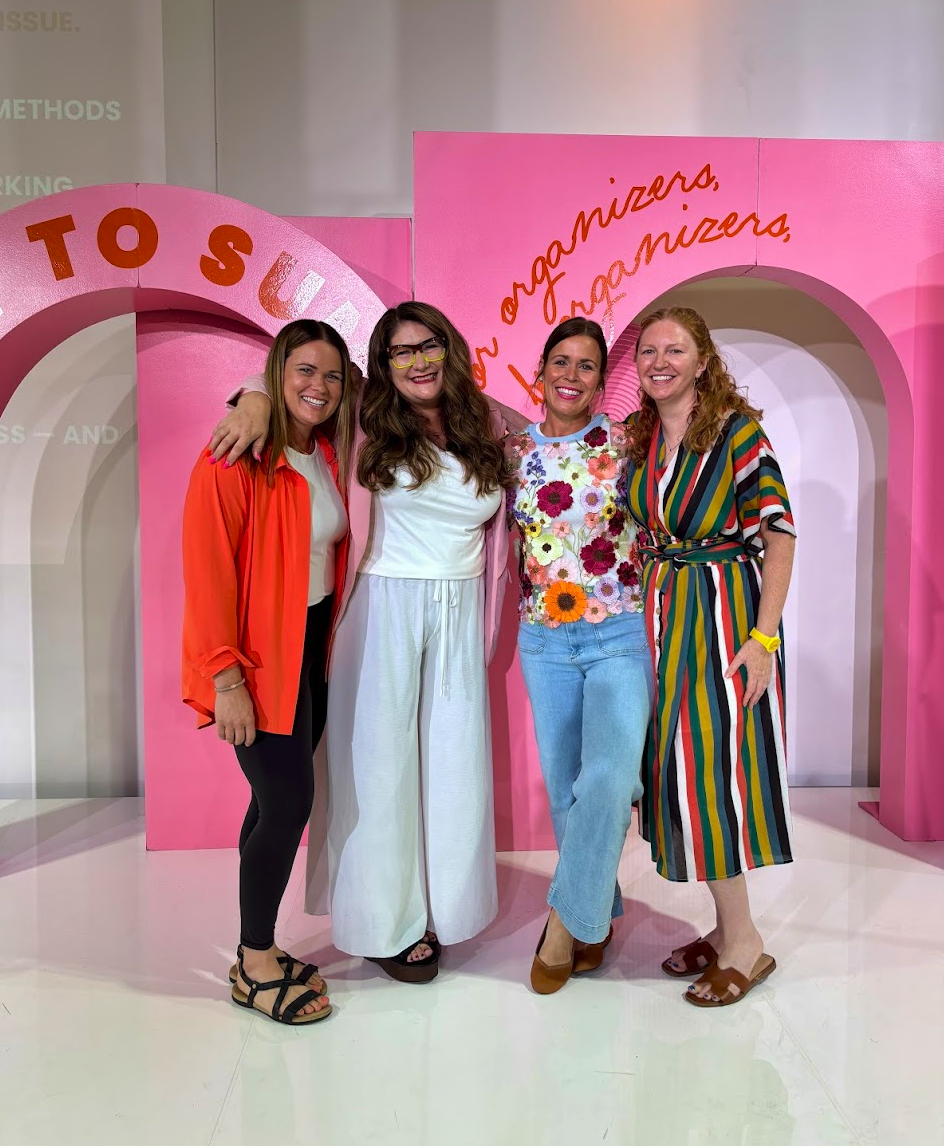
Meet Cori, Kielyn and Missi.
Find your organizing community—you’ll never regret it!
You can listen right here by pressing play, or you can read the full transcript below!
Or if you prefer YouTube, we’ve got you covered HERE!
LINKS FOR LISTENERS
Connect with Melissa and Pro Organizer Studio: CLICK HERE
We have a whole library of podcasts here, our YouTube channel, and you can find us on Facebook and Instagram at Pro Organizer Studio.
FULL TRANSCRIPT
Hey, pro organizers. It’s Melissa, and I am back with part two of my conversation with my organizing besties here in the Twin Cities, Missi, Cori, and Kielyn.
In this episode, we are talking about a lot of things that I think organizers as a whole, including all four of us, struggle with, which is the idea of fear and, you know, doing things scared in our business and all sorts of other things.
We’re also talking about just being really, really authentic and how you come across to your potential clients and all sorts of other stuff, including how we handle big mistakes that we make because yes, we make mistakes too.
All right. This is part two. And stay tuned for more content this week from Pro Organizer Studio.
Melissa Klug: Kielyn, tell me a little bit about when you think about the idea of fear—or in business—do you operate from a place of fear, or do you operate from like a, “It’ll just be fine”?
Kielyn Simonson | OrgaNice: I started in a place of fear when I started my business seven years ago. I was scared shitless, and I remember calling my business coach like every other month and I was like, “What am I gonna do? I don’t actually have another client coming. I don’t know what I’m gonna do. This is probably over,” blah, blah, blah, blah, blah.
And he was like, “You gotta stop. You cannot think that way because you have to trust that the universe is going to work itself out and you’re getting what you need.”
And so then I met my friend Ann in Des Moines—Happy Healthy Home Des Moines. And she told me—I had a cancellation or something, it was really early on—and she was like, “I’ve been told every cancellation is a gift. Take that day and do with it what you need to do, enjoy that time. It’s going to always be a good thing.”
And so since then, I feel like I’ve been making a lot of progress in just understanding that things do tend to work themselves out. And when it’s been slower, it’s usually because there’s a personal need that I have for either rest and recovery, or my family needs something, or my kid gets sick. It just always tends to work itself out.
And so I think that is my general response now is, “Okay, it’s a little slower right now. It’s fine. I’ll enjoy the time. I’ll be busier in a little bit and I’ll be glad for it.”
So that helps.
Melissa Klug: I love cancellations.
Kielyn Simonson | OrgaNice: I love it. They’re quite—
Melissa Klug: —nice.
If all three of you would’ve told me that you couldn’t do the podcast today, I’d be like, “That’s fine. I’m gonna sit on the couch under a blanket,” like cancellation.
All joking aside though, I—one of the things that a lot of people bring is, “Well, I need a policy for this, and I need a cancellation policy, and I need this policy, and I need this policy.”
And I’m not, by the way, saying that you should never have a policy in your business. They are important, especially the bigger that you get and the more people you’re serving.
But I do think that there are some things sometimes that you feel obligated—“Well, everybody else seems to have a cancellation policy, so I need it too.”
What I have personally found in my organizing business is, if someone cancels, I am thrilled because I need that time. Like you said—then go use it wisely.
Right, right.
And wisely can be a large—there’s a large definition of what is wise. It could be nap time. It could be whatever.
I think that’s really important.
So Cori, I know that you do not operate from fear, but what do you see?
Cori McDougald | Meat & Potatoes Organizing: No, I do. I’m like, “Oh, interesting.”
I not like fear, as in—so my favorite quote is “feel the fear and do it anyways.”
Because if it freaks you out, it’s probably for the best, in one way or another. Maybe it is gonna be terrible and you’ll learn then too, right?
Yeah.
I think the other thing people forget is that we’re actually human beings. And human beings make a lot of mistakes.
Yeah.
And the beauty about being a human being is that even if you make a mistake, there are second chances. There are chances to learn, grow, make a different choice next time. You can learn and you can make a better choice.
And that’s why I tell myself—so like I get very scared when I’m pursuing like the professional athletes. I love it, but it’s also very scary.
And even when you land one of these huge projects, it’s a lot and it’s high pressure and everyone has to perform at their best. It’s like organizing but on steroids, right? And everyone knows it.
But you gotta feel the fear and you just gotta commit and do it anyway.
Yeah.
And then it’s—that’s where the fun really happens for me and my team, I think, too.
So I am afraid a lot. I also have a team that I feel obligated to make sure they have hours, and that can be scary because most of the time leads come in ’cause we’ve got good SEO, ’cause we follow the things that Melissa tells us to do.
Yeah. Those are checked off the list, right? We know that’s happening in the background. That’s great. So that’s where your new leads are coming in.
How are we nurturing the people we’re currently working with? How can we get them to rebook? How can we make them schedule more—longer, better sessions?
But basically, there’s things you can control. There’s things you can’t control. And most of the time, I do worry a bit about keeping all of my organizers busy.
And there are slow times and there are busy times. And of course, like if I had an extremely robust business set up, I would not have slow times, and I’d have things to do in the downtime.
But I’m just gonna be honest and be like, yeah, sometimes it’s just really slow.
Yeah.
You just have to do our best with what we have and the tools we have. Luckily, we have lots of good tools with Pro Organizer Studio and Inspired Organizer on the business side.
Set up your systems—that’s all you can do. That’s what’s in your control.
Yeah. Yep.
And the rest of it’s scary, to be honest.
Yeah. No, it definitely is.
Melissa Klug: But one thing that I wanna tag onto that you said that I think is really important in this—there was a coaching session that we did in our group, and someone was talking about like how the news, which by the way I don’t care for—you’re—the news isn’t great right now, right?
Like there’s not a whole lot where you’re like, “Boy, that’s a warm, fuzzy story.” There’s a lot of really dark stuff happening, right?
And this person said, “I can’t. I’m just too upset by all the things out. I can’t—” She had things going on in her personal life, things going on in the news, and she goes, “I can’t, I literally can’t do anything in my business because I’m so preoccupied with all these other things.”
And as we were talking about the affirmations and manifesting—like when we say we’re putting those good things out, you can also really internalize a lot of bad things. And that can sabotage any progress.
Like I just—I like to think about, yeah, there are things that I can control in my backyard. That’s all that I have control over. I do not have control over things that are happening on a global scale.
But I can control how I go into every day. I can control what I’m doing.
I can say, “I’m not going to let the following 25 things stop all my forward progress.”
I think that’s where fear can get you into a bad spot, is if it halts all forward progress.
And that can be on a micro level too. “I’m afraid of blogging, so I’m never gonna write a blog.” No.
I just want you to figure out how to blog. I want you to say, “I don’t like this. I’m afraid of it.” Whatever the phrase is.
Or “I don’t like networking.” Okay. Why don’t you like networking?
“I am an introvert.” Okay, cool. Let’s find you something.
There are ways around all the things we are afraid of, but a little—
Cori McDougald | Meat & Potatoes Organizing: —dose of it. A little dose of it’s okay, right?
These are just things that you have to do.
If I had a corporate job, I guarantee you my boss would give me a whole much longer list of things I hate doing.
Yeah.
At least when I work for myself or we’re working for ourselves, like you are in control of that list, and you can dabble a little bit of fear, a little bit of discomfort, a little bit of “ugh,” but you just do a little bit of it, right?
And each little bit adds up.
If you hated SEO but you just did a little bit of the course, right? Okay, I just did a little on my Google business profile, then I did a little on my website, and then I did a little— all of those things like multiply and exponentially help you, even if you hate it, and you’re scared.
“If I put my blog out there, what are people gonna think of my words?” Well, no one’s reading your blog, but SEO is gonna find those words and you’re gonna get 15 new clients this month.
So you gotta suck it up and be a little bit afraid to like get—eat your veg—eat your vegetables, right?
Melissa Klug: Right. Eat your work broccoli. That’s—yeah.
Cori McDougald | Meat & Potatoes Organizing: Or find somebody on your team or VA that can do it for you.
Melissa Klug: Yeah, absolutely.
Again, the thing that kind of brought us here originally—the thing that’s keeping us here—is friendship and ADHD, but the thing that brought us here is that idea of “I have to ask everyone’s opinion about this thing before I do it” versus trusting your gut.
And I do think that’s a unique—it’s a unique part of entrepreneurship because you’re like, “Oh my gosh. Well, what if I’m—I am the only one who makes the decision.” And sometimes that is scary. “What if I make a bad—”
But the thing that I come back to in organizing—I don’t know if you guys agree with this or not—there aren’t a whole lot of mistakes you can make that are like irreversible, I don’t think.
Missi McKown | Clear Spaces Organizing: Just a few. And I think we’ve all made ’em.
Melissa Klug: Yeah. Yeah.
But like truly—what—do you have something that you would define as, “Boy, that was a big mistake”?
Not to put you on the spot, but—
Missi McKown | Clear Spaces Organizing: No. Yeah, I will.
A client saying, “Yes, that can be donated,” and then you donate it, and then they call you the next day and are like, “Where’s that thing?”
And I’m like, “That thing that you said to donate— that thing—well, it’s been donated.”
“What? No, I didn’t want that donated.”
And so then you run to the donation store and you talk to all the staff and it’s gone.
And then you don’t believe it’s truly gone until you talk to the cashier that said, “Oh yeah, I remember selling that.”
Yeah. It didn’t last long.
And I’m like, “No.”
Yeah.
So then you might look on eBay, see if you can find it. Offer to buy it back for the client. They say no. And so then you just offer ’em some money anyway. They say no, and then you just send it to them anyway, because that is the only thing that you can do to try to make it right, because you have made a mistake.
Kielyn Simonson | OrgaNice: Did I tell you about how I sent a client’s entire wardrobe to the storage unit instead of her house?
Melissa Klug: No.
Kielyn Simonson | OrgaNice: Early on, we’re doing a move and unpack and she was moving into her daughter’s for just a while and then the house was getting built. So it was complicated ’cause it was the stuff that was gonna—the daughter stuff that was gonna—the storage.
And I was in a lot of different places trying to direct the movers and everything.
And at one point, somehow the clothes ended up in the storage unit truck.
And she texted me that night, “Hey, so where’s my clothes? I don’t have any clothes.”
And I was like, “Oh no.”
And I said, “I will solve that problem for you.”
And the next day she went to the closing for the house in a swimsuit coverup.
Melissa Klug: Oh, I do remember the swimsuit coverup. Yes.
Kielyn Simonson | OrgaNice: And that was at like 8:00 AM or something.
And then by 9:00 AM I had gone to the storage unit, got a little step stool, climbed myself to the top of it, retrieved the bags, and brought ’em to her house.
But it was like—I felt like I was gonna puke when I got the first text and then I just laughed for a solid hour, ’cause it’s just the most ridiculous thing in the world.
Yeah.
Ultimately I apologize, we laughed about it, and I was like, “I’ll never make that mistake again.”
It’s—what do you do, right?
Thought it was funny.
Melissa Klug: But we have a lot of people—I see this comment a lot—of someone will describe a terrible situation where you’re just like, “Oh, just run away from that client. You do not need this in your life.”
And then inevitably the last sentence will be, “But I don’t wanna get a bad review so I might stay with them because—”
And I just think that’s another example of we—the reason we’re talking about—we’ve all made huge varying degrees of mess-ups from small to huge.
And if you are operating from that worry about a theoretical thing that might happen, but probably won’t—but it might—so I need to do that—that can send you in a whole other tailspin.
I can—totally two things with that.
Cori McDougald | Meat & Potatoes Organizing: First, if you get anything other than a five-star review on Google, it actually verifies your profile and makes your profile stronger because it makes you authentic.
Yep. A 4.9 is—
Gallery View & Screen Share: Better than a 5.0—
Cori McDougald | Meat & Potatoes Organizing: Dang it. Correct.
So if you do get a negative review, it’s actually not a terrible thing. And I’ve heard that from multiple bang up SEO places.
So yeah, that’s the first thing.
Second thing: we work with disorganized people who—to just get them to leave you a review—very challenging.
Oh my gosh. Yeah.
So I’m just gonna say the odds that they’re actually gonna leave you a review—yeah—very small.
It is very small and you can always respond to it. And then it’s gonna beef up your SEO and your Google profile.
Yeah. I don’t know. But I also get nobody wants a bad review.
Melissa Klug: Yeah, I get it. But you’re absolutely right.
Missi McKown | Clear Spaces Organizing: I’m gonna agree with you.
Like, you—if someone does leave a review, it gives you an opportunity to respond and for people to understand you more.
’Cause people are gonna read the bad review, but they’re also gonna read your response to it.
Totally percent.
And I have done that a million times for different—from everything from a restaurant to a hotel to varying different things around the Twin Cities—to see how does the owner reply.
And there are some owners that get really defensive and I’m like, it probably means that there’s a lot of truth to what that person said.
But there’s a lot that can be said per just your integrity alone in how you choose to reply.
Part 3
Melissa Klug: Totally. I’ve told this story before, but it’s buried 700 podcasts ago.
I have done marketing for a non-organizing client for many years, and she got a bad review one day. She has a physical store, and she got a bad review one day and she was like, “I’m gonna respond and I’m gonna do—” she was really mad, which by the way, it was legit reason to be mad.
But I was like, “Nope, you’re gonna do nothing of the sort. First of all, we’re just gonna let this sit for a day. We’re just gonna let it sit. We’re gonna let tempers calm down and then here’s how we’re gonna respond.”
And I wrote her a very professional, very polite, but direct response. And she had someone come in a week later and she told me, “I’m really glad that you stopped me from writing that reply.”
Because she had a guy that came in and said the reason he came in is because of how she replied to that negative review. Like he said, “Oh, that was really classy.”
Literally a one-star review made him come into her store.
Gallery View & Screen Share: And so—
Melissa Klug: I know that it’s a scary thing, but also it’s almost never going to happen.
Like we have a thousand people in Inspired Organizer and I can only think of one time in the last year or two that someone has said, “I got a bad review. What do I do about it?” It doesn’t happen.
So you’re being—you’re afraid of a mythical thing basically, but that fear is real and I do understand it.
Cori McDougald | Meat & Potatoes Organizing: Yeah. Yeah.
Side tangent from that for authenticity and like doing what you think is correct—okay. Another thing Missi and I were saying—we’re like, sometimes we listen to what Melissa says, but other times we listen to our gut and just do whatever we want.
Not that like, Melissa, you give amazing advice and it’s always spot on, but sometimes that doesn’t sit right or doesn’t feel right with somebody. Yeah.
And you know what? Then you gotta listen to your gut and you gotta listen to what feels right for you.
We’re absolutely different situations, and that’s where—it’s even if you saw Melissa or Cabri or anybody else respond one way to one post in Inspired Organizer, that might not feel right for you and you might need to do it a different way.
And I’m just saying that’s okay. Yeah. Don’t feel bad about that.
Melissa Klug: No. I have 1% of the answers. And I don’t know how anybody is running their business, their life, what their ethics are, what their business looks like, what their bank accounts look—look, I don’t know any of those things.
I’m just saying, “Hey, here’s the suggestion,” and you don’t have to take it.
We had one the other day in the group that—that AI comes up a lot and someone was asking like an ethical question, yeah, with regards to AI about like editing a photo.
And what I liked about that is I was like—I had a pretty strong opinion about it as I usually do. And I put it out there, but I was like, “That’s me. You can do whatever you want.”
And then we had people that were going back and forth on the pros and cons of this particular issue.
But none of us have all the answers, right?
I don’t care if you have—we have people in our group that are making close to a million dollars a year revenue in their business. They don’t have all the answers either. They might not have a different set of answers than the person making $10,000 a year in their business.
So we—and that’s—you need to go with your gut.
Cori McDougald | Meat & Potatoes Organizing: I think we were talking about too—look at the data, right? Like the data for your company—what does that data look like? And then make your next decision.
It could be very different. Even though Kielyn and Missi and I all have teams in Minnesota, you would think, “Oh my gosh, they must be so similar.”
I guarantee you the data is all over the board. Yeah. If you were to line it up, right?
Totally. And so you need to look at your situation, look at what does the data say to you.
Gallery View & Screen Share: Yep.
Cori McDougald | Meat & Potatoes Organizing: And how do you want to respond as a business owner? Yeah.
Kielyn Simonson | OrgaNice: Right. And everybody’s personality is different and their ideal client is different, right? And your team is different, and all of that is different.
And so when we’re looking for clients, really what we’re hoping for is the client that will pick the best person that will work well with them. And you—it’s like that whole lid-for-every-pot thing. Yeah.
I’m not everyone’s cup of tea. But everybody has their person that’s yes, you are exactly what I need. Yeah.
Melissa Klug: Absolutely. Yeah.
Cori McDougald | Meat & Potatoes Organizing: And I think one thing that a lot of people—not that I just, I keep like blabbing on—but one thing that I think business owners, especially professional organizers, need to think about is being more themselves.
Kielyn Simonson | OrgaNice: Yeah. Be more—
Cori McDougald | Meat & Potatoes Organizing: —of you. Thank you.
The client wants you or your team, but they don’t want me, they don’t want Melissa, they don’t want the rest of us. Like they want you.
What makes you excited? What makes you passionate? What makes you—why did you get into this? And show that to people. Show them that on your social media. Show them that on your stories.
Missi does an amazing job of showing us who she is on her stories. And like her clients vibe with that and they respond to that and they keep in touch that way.
And so like just be more of you. Yeah.
I think listen to yourself and what do you need? And if you have to look at data, of course, look at data too.
But nobody needs more of the million-dollar organizer that might look really great in your eyes, but that might not be you.
Yeah. Okay.
Melissa Klug: I could talk about this topic for a thousand hours because I believe it so deeply.
The one that always hits me is so Marie Kondo—when I was in Japan and Marie comes out—and I have been in the room with her a few times, which I’m very grateful for—but she is the most calm, quiet, just calming, wonderful presence, right?
She walks in the room—people that just have the X factor of you can’t explain it, you just, you know it, right? And she just brings this air of serenity and tranquility.
And I was like laughing to myself ’cause I’m like, I couldn’t be more opposite of that. If I tried to be Marie, it’d be the worst—like it’d be so fake—and it’s ’cause that just, it is not who I am and how—
But she also couldn’t be me, right? She is not gonna get up in front of a group and try to make ’em laugh and have—and just go off the cuff. Like, we could not be more different, right?
But being authentically who you are connects you to people.
And if you think it doesn’t—like if you say, “Oh, I need to dial down this part of myself because maybe this such-and-such client won’t like it,” they’re not gonna be a good client for you because when you get there, you’re gonna be miserable.
Like just freaking be yourself. If there’s something you’re really into, talk about it. Even if it’s weird, because when you are yourself, you can be so relatable.
I think that people go, “Oh, I see myself in you.”
Kielyn with dog of the day—I—
Cori McDougald | Meat & Potatoes Organizing: I love—
Kielyn Simonson | OrgaNice: —the dogs.
Melissa Klug: Kielyn loves dogs. You love dogs. Your clients love dogs so much. And that’s like—
Cori McDougald | Meat & Potatoes Organizing: —such a huge bonding.
Kielyn Simonson | OrgaNice: I’m always like, “Okay, if you’re gonna send me some photos, can you also send me photos of the dogs, please.”
Melissa Klug: Yes. Yes. And we can bond over our love of dogs, so by the way, absolutely.
Here’s one thing I will tell you that you should fake: if you don’t like animals, you better pretend like you do. Yeah, a hundred percent.
’Cause I’m telling you, people love their animals. Yes.
And if you go in—like the line that I always use with people is when they’ll say, “Oh, I have a dog. Do you mind dogs?” And I go, “If I minded dogs, I wouldn’t be a professional organizer.”
Kielyn Simonson | OrgaNice: Right. But—
Melissa Klug: Kielyn, like genuinely, that is a genuine love of yours.
Kielyn Simonson | OrgaNice: Yes. And I’m always—they say, “Well, do you want me to put ’em away?” And I’m like, “I really prefer you don’t. Thank you.”
Melissa Klug: Yeah. If you do put ’em away, I’m leaving. I’m actually gonna be a little bummed out, so please don’t.
With the exception of ankle biter dogs that like come around and bite your ankles every time you try and move. I’ve had that a couple times. Yeah.
But yeah. But usually, yeah, I do love the dogs.
Missi McKown | Clear Spaces Organizing: I wanna talk about the authenticity piece that Cori was touching on too, of just being who you are.
I think people are getting more and more used to having AI summarized things for them that they don’t even—that they’ve not asked for. Right.
Our emails are summarized, our text messages are summarized, and I feel like it is more important now to have that human connection.
I know a lot of organizers who are using AI to write their newsletters. That’s fine. Whatever. And people can tell when you don’t.
Like the feedback that we get about, “Oh my gosh, this is—I felt like you were talking directly to me,” or whatever it is. They can sense that when you’re putting your whole self into whatever it is.
Yeah.
Melissa Klug: I could not agree with that more, and especially—so Missi writes really good newsletters. There are different things that we’re all good at.
Missi is really good at writing newsletters to her organizing audience. And the reason is—and we started talking about it before we hit record—but what was the—what was your email title?
Missi McKown | Clear Spaces Organizing: So the highest open rate I ever received on a newsletter was one entitled, “I Wasn’t Actually Dead.” And you know how you can do like the subheading or whatever—despite how it looked. Right.
Melissa Klug: Okay. So I wanna just parse that for one second because when you think about that—okay—that’s a bold statement, right?
And you put it in an email subject and sent it to several hundred people, right?
And I think there are a lot of organizers who would say, “No, I have to have an exceedingly professional ‘Organize your kitchen in 10 minutes’” or whatever.
Everybody has this perception of the right and professional and good thing to do. And I’m telling you—that’s—frankly, it’s boring. I’m just gonna say it.
Gallery View & Screen Share: It’s boring.
Melissa Klug: People aren’t gonna be interested in it, it’s not going to grab their attention in a mailbox.
And like sometimes do the unbuttoned up thing. Do the unprofessional thing. Do the thing because that’s what people are looking for. They really are.
Missi McKown | Clear Spaces Organizing: I was really hoping you were gonna break into a little bit of Pussycat Dolls, “loosen up your buttons.”
Melissa Klug: Yeah, I could—
Gallery View & Screen Share: I know all the words.
Missi McKown | Clear Spaces Organizing: But—and I just wanna be fair to those folks too ’cause there are some buttoned-up type A people that attract other buttoned-up type A people.
Melissa Klug: A percent. Yes.
Missi McKown | Clear Spaces Organizing: So it is—if that’s who you are, still be who you are, and know that’s going to attract the same kind of people as you, which is awesome.
’Cause you probably feel really comfortable working with people like you.
Melissa Klug: Yeah, totally.
Yeah. I think about—there’s one client in particular I could think about that I’m just like, I could not be less of her cup of tea.
She’s all business. She does not want to—and I just go, I think there’s maybe another organizer that she would vibe with a lot better than me because I’m a little bit more, “Oh my gosh, lemme see these new Legos that your kids got,” or whatever.
Yeah. She’s not that person, right? She does not enjoy that.
And so yeah, you should be exactly who you are in the same way that like, if you are extremely buttoned up and you have a very specific clientele and a specific vibe you’re going for, don’t try to be like me.
Don’t send an email that says, “I almost died.” Like whatever.
But just do the thing that makes sense to you, and you’re exactly right—you’ll attract the right people.
One of the things that we talked about—Cori, you said at the beginning before we started—hey, let’s—you can just do the thing, like you can make changes and you can pivot in your business and you can just do the thing.
Can we talk about that a little bit?
Cori McDougald | Meat & Potatoes Organizing: This kind of goes back to like my grand vision of what I want and what I think is right at the moment in the company, right?
And so I like to prioritize things because I also have ADHD and it’s really hard for me to focus on a million things.
So I write my priorities down. I write ’em down every week. And as soon as I have enough caffeine in my body, I also know that I can operate a little bit better in the morning.
I’m not a night owl, I’m a morning person. I’m a weirdo.
I give myself—I got like a good hour of productivity. I’m gonna be honest. I don’t know how everyone’s productive for eight hours a day ’cause I’m not. Like, it’s really hard.
I’ve got a good hour and then it’s brain fuzz from there on out.
So I try to do my most meaningful work in the morning, and I do time block and I do the things that I don’t wanna do, but I have to do them.
I take small steps.
It’s okay, I’m just looking at it right now. We just had a planning for the year, a fiscal meeting, right?
So I shared with my two lead organizers who are running different parts of the Twin Cities: here’s our financial goals for this year. Here’s how we break it down by quarter. Here’s how much we wanna bring in. Here’s how many leads we need, how many sold projects, blah blah blah.
And so one of the things on there—one of the easiest ways to improve your profit is to decrease your expenses.
Well, guess who doesn’t like getting on the phone and decreasing all of the expenses? Like calling Verizon and—
Worst. I hate all of that.
But guess what? It’s necessary for us to hit the goals we wanna hit.
So on Tuesdays, I have blocked out work on expenses. Okay?
So that means this Tuesday I will spend an hour plugging away through that, and then I’m just gonna let it go.
But that’s a huge step, right? Because if I did nothing and just put it off—if I do one or two things, that’s way better than if I were to just put it off.
And it affects everybody in the company, not just me. It affects my lead organizers because we do like a profit-sharing model, right?
So it’s their incentive to have the most profits at the end of the year because it gets divided amongst them.
So it’s not just me anymore. It affects everybody.
So I would say break it down into really small, manageable pieces.
There are also things that I need to check on with the website. SEO. Do I love doing that? Nope. But it’s on the list and I’m gonna do it.
Melissa Klug: Yeah.
Cori McDougald | Meat & Potatoes Organizing: And is it important? Yes. Yeah.
The other thing I have on my list every week: by the end of the week, I have to do one scary thing.
And—oh—I do one scary thing a week.
And most of the time I’m a very big procrastinator. It happens on Friday at 3:30 because I wait until the last possible minute to do it.
And it’s generally asking or starting a conversation with somebody that I wanna work with, that I see a good future for us—maybe a good marketing opportunity or a collaboration.
And I did that this week and I knocked a huge one out of the park, and I’m so excited to share when we finally get to that point.
Melissa Klug: That’s awesome.
Cori McDougald | Meat & Potatoes Organizing: But every week I do one scary thing.
And I—Missi not afraid of anything—but I am, I have a lot of fears and I write them down and I tackle them one—one a week.
Melissa Klug: But by the way, that scary thing could literally just be “I have to call Verizon.”
Cori McDougald | Meat & Potatoes Organizing: True.
Melissa Klug: Like it doesn’t have to be like the biggest, scariest thing. No, I’m gonna go ask the governor of my state to organize his house. Right?
It could just be, “Boy, I hate calling my insurance company, but I’m gonna do it.”
Or I am going to—here’s a scary thing—I’m going to open up my business checking account and check and see what are things that I am spending money on that I might forget that I’m spending money on.
Or I am going to do some of that math.
So the math that you’re talking about I know is something that I do not enjoy doing. Where you go, “Okay, I wanna make this much. How do I break it down? How many consults a week? How many blah blah blah whatever?”
Like that can be your scary thing too. It’s whatever you are like, “La la la, not gonna worry about it.”
That—I love the “do one scary thing.”
Cori McDougald | Meat & Potatoes Organizing: Some people work well at night. Like if you’re a night person, flip it. Yeah. Don’t do it in the morning. Wait until you get your little excitement hour and then do it then.
Melissa Klug: Yeah. I’m in on it.
Missi McKown | Clear Spaces Organizing: Well, I was just gonna add, because I think saying I’m not afraid of anything is a little too broad of a stroke here.
I am a really good procrastinator at really small, important things.
Like Melissa alluded to it earlier, and I can’t remember if we had already hit record or not yet, but sometimes I will forget to invoice someone for six weeks. So that’s like a—
Melissa Klug: Me too. I do too.
Missi McKown | Clear Spaces Organizing: It’s an important thing. And I’ll even know that it’s important.
And I had that this past week for four days. I was like, “I need to send the invoices.” And they were prepped and almost ready to go, and I just couldn’t like cross that finish line and—insert reasons here.
I don’t know if we’re—you’re gonna do an intro at the beginning of—we’re all living in the Twin Cities right now in January 2026, so it’s affecting us and our clients and yeah.
Anyways, there’s reasons that things are harder to do right now in general, and that also happens all throughout the year.
So just to—I don’t know—maybe a little reminder to cut ourselves some slack.
I think I am always gentler on everybody else but myself.
Kielyn Simonson | OrgaNice: Oh, a hundred percent.
Melissa Klug: Yeah.
Missi McKown | Clear Spaces Organizing: Yeah. Yeah.
Melissa Klug: I think there’s a difference between “I need to push myself all the time.” This goes back to when Kielyn and I talked about like, “Why can’t we relax? Why can’t we rest?”
Like why do I feel guilty when I’m just watching a TV show and not doing 12 other things?
And I think that we have this pressure on ourselves that like, “I’m supposed to be blah blah blah.”
Maybe really the most important thing you need to be doing at that moment is just saying, “I need a hot second of peace.”
And that invoice can sit till tomorrow. Like six weeks in one day is—like six weeks in one day. It’s still gonna live. Or four days plus one day—it’s all gonna be okay.
Thanks for listening today, and stay tuned. I’m gonna be back with lots of stuff this week, including something brand new we have, which is a teams program.
If you are a team builder—if you currently have a team, if you want a team—so many good things coming for team leaders and business owners, so stay tuned for that in a couple of days.
If you have anything you need in the meantime, reach out to me: hello@proorganizerstudio.com.
Talk to you soon, organizers.
CONNECT WITH PRO ORGANIZER STUDIO
We’d love to work with you. Send us an email (Melissa answers them personally!) or connect with us HERE…or check out our programs HERE.
If you’d like to watch our FREE seminar, The Pro Organizer’s Profit Plan—check it out here!