

248 | The One Where Melissa Needs a Lecture from Cabri

When I have something that I can’t work through, I go to Cabri—because she gives me no nonsense advice.
Today, I spill a story about how MY garage—became overrun with my client’s stuff because I didn’t have the right expectations in place.
We’re talking through it and how even experienced business owners fall into this trap!!
You can listen right here by pressing play, or you can read the full transcript below!
LINKS FOR LISTENERS
Connect with Melissa and Pro Organizer Studio: CLICK HERE
If you are interested in our Inspired Organizer® program, you can find us at www.inspiredorganizer.com
We have a whole library of podcasts here, our YouTube channel, and you can find us on Facebook and Instagram at Pro Organizer Studio.
FULL TRANSCRIPT
Melissa Klug: Okay, so we’re here on the podcast for Cabri to give me a lecture. Is that what we’re doing here today?
Cabri Carpenter: We are.
Melissa Klug: Okay.
Cabri Carpenter: I didn’t even know what the lecture was about until—no—
Melissa Klug: Recently? You’re prepared to give me a lecture, right?
Cabri Carpenter: Oh, always. Duh.
Melissa Klug: Alright, good. This is why we have a good relationship.
Okay, so I want to just spill a little bit of a story, and there will be a picture that will accompany this. If you go to proorganizerstudio.com/links, you can see this photo. We’ll probably put it up on social media too.
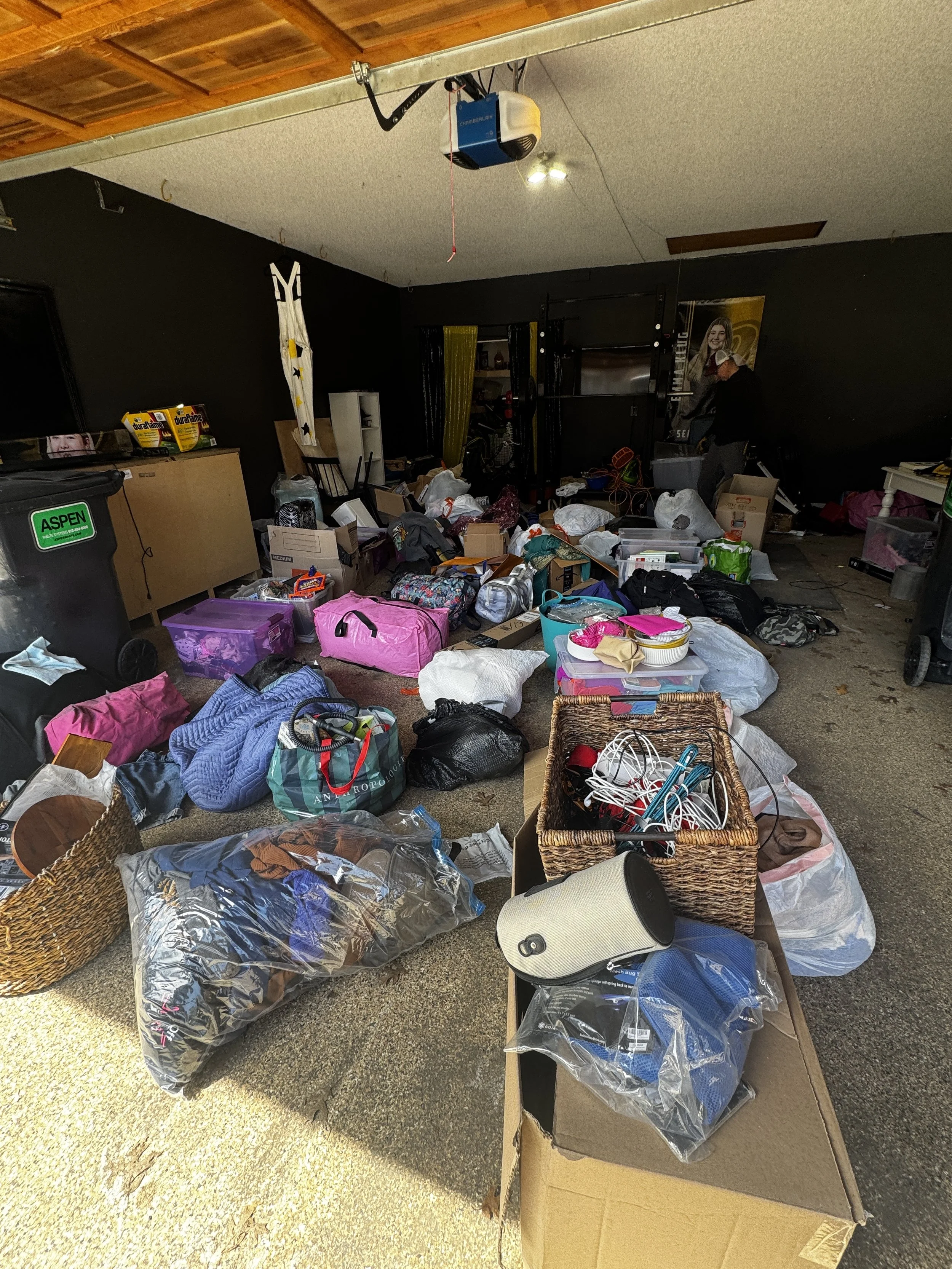
How my garage got overrun with wayyyyy too much client STUFF…
But I had an epiphany this weekend, and I do a lot of—I have a lot of growth that I need to do. And so, you know, every once in a while I look around, and I talk to organizers all the time, and I give people advice all the time, and sometimes I don’t take my own advice.
Do you have this problem too, or is it just me? I know I’m not alone.
No, I mean, I think we all probably have this problem to some extent.
But—no, I’m gonna yell at you whenever we finally get to this.
Okay, no, that’s good.
Okay, so here’s the story.
I am, like I said, working on myself. I am very aware of my shortcomings, one of which is I very much am a people pleaser. I’m an Enneagram Two. Hard Enneagram Two.
One of my favorite things—I’ve talked about this before—it was an Instagram that says, “Enneagram Two gets kidnapped,” and the Enneagram Two is, “Hey Mr. Kidnapper, you seem really tired. Do you want a snack? I have a snack in my bag.”
Like, that is me to a T.
So I’m like, what can I do for you?
And one of the things that I really have believed has been very good for my business—and it has gotten me a lot of business and has gotten me a lot of happy clients—is also sometimes my shortcoming.
I am a big believer that you say yes, and then you kind of figure things out.
Okay, but “yes” can go way too far.
And the epiphany that I had this weekend was I was staring down a garage full—I’m very thankful, very thankful—I have a giant garage. I’m very appreciative that when we picked this house, it came with a really great garage.
Okay.
But the bad thing about that garage is it can just hold a lot of crap.
And so what has happened in my organizing career a few times is that I will just say, “Oh yeah, I’ll just take it,” or “I’ll hold it for you,” or “It can just go in my garage,” or whatever.
And in this particular case, I have a long-term client. I have talked about her probably on this podcast. I’ve talked about her in Inspired Organizer® many times. Long-term client that I—I’m gonna be honest with you—I have babied.
I have babied, and I have blurred the lines so much that I—like, the only word I can use for it is codependence, which is probably not the right word, but maybe.
Cabri Carpenter: But you’ve created that relationship with her.
Melissa Klug: One hundred percent. Yeah. Like, “I’ll just handle it. Do not worry about it. You don’t have to think about it. I will take care of it.”
And so that is how I found myself—
By the way, this is an important part of the story.
She is the only client that I have ever had that I begged to get a storage unit—not get rid of one, but to get one—because she would refuse to give away anything. She would never want me to cull. She would never—but I’m like, there is no more room here.
Okay.
So I was like, could we please get a storage unit, and I will move some of your things that you’re not really using as much in there?
Well, guess what happened?
That storage unit needed to be cleared out.
Ask me where it went.
Cabri Carpenter: I’m gonna assume this very large garage that you have.
Melissa Klug: Very large garage—which, by the way, is not infinitely sized.
Okay? It is not a 17-car garage. It has an end to its ability to store things, including the cars that we need to park there—because I live in Minnesota and it snows and stuff.
So anyway, I found myself this weekend staring at a giant garage full of my client’s crap—that had been—yeah, I called it crap—stuff that has been sitting in a storage unit for two-plus years, hasn’t been touched.
I had to clear it out, and it landed in my garage.
And I was really resentful.
Cabri Carpenter: Can I ask—how long has it actually been in the garage?
Melissa Klug: It’s been there since mid-January. That’s what I mean—it’s been there for a while.
And here’s why, in my defense:
One, I have been super busy. I was just like, I’m just gonna put it in there, and I’m not gonna worry about it. I’m not gonna think about it until the spring.
Yeah, because my garage is not climate controlled, so it’s cold out there.
And the second thing is that I didn’t have a burning platform, right? Like, it could just sit there.
But it was starting to get in my way.
So I would pull the car in, and I’d be like, “Oh, I gotta move this bag of clothing,” and “I gotta move this box of kitchen stuff.”
And I was just like—I just really got mad.
And I got mad at myself for allowing it to happen.
I got frustrated with my client, which is not fair because I set the boundaries and I set the rules—but I did get annoyed at her.
Then I got annoyed at myself again, and I just said, I created this entire situation.
Cabri Carpenter: Mm-hmm.
Melissa Klug: I did it to myself.
Cabri Carpenter: Unfortunately.
Melissa Klug: Yes.
And I just said—I had this moment where I said—I can’t do this anymore.
And by the way, I have a million things. It’s not okay.
So my garage—the junk guy came today—my garage is looking amazing right now. Like, amazing. I’m so happy.
But guess what?
My front closet has a bunch of client stuff that I’ve just never really dealt with.
Cabri Carpenter: Same client or a different client?
Melissa Klug: Totally different client.
Cabri Carpenter: Okay.
Melissa Klug: Yeah, totally different client.
But I have these little reminders of my business that have infiltrated my home.
Cabri Carpenter: Mm-hmm.
Melissa Klug: And so really, I just want to come on here and say—first of all, if you think that Cabri and I do everything perfectly in our businesses, we do not.
We do not.
None of us are doing things perfectly.
But I also just want to give people the permission to—like you—you’re able to say no, and I’m terrible at saying no, but it really, it’s really critical.
So anyway, I’m prepared for a lecture. Let’s go.
Cabri Carpenter: Well, okay, so before we just start lecturing, can I ask—what would have happened if you had told her, like, no, I’m not taking this stuff? Like, it needs to be within the boundaries of a session. I need to take it at the end of that session and do something with it. There’s no time to make ongoing decisions or take a long time to make decisions.
What would that conversation have looked like?
Melissa Klug: That’s a great question. I think that’s important to this conversation because part of what was happening was they wanted to be out of the storage unit. Like they said, “We don’t want to pay another month.”
Cabri Carpenter: Mm-hmm.
Melissa Klug: And so I then said, oh, okay, well I’ll just—I’ll get the stuff out. I’ll get it taken care of, because I always just get it taken care of.
Cabri Carpenter: Yeah.
Melissa Klug: I think that I should have just said, “I’m really sorry, I am not available. I need to dispose of these things as we go. I need another month,” or “I’m gonna have to give you one of my colleagues to be able to do it,” or something like that.
I also think that this is another flaw that I have of—I’m very much a, “I’ll do it.” And you know that.
Cabri Carpenter: Mm-hmm.
Melissa Klug: I’ll do it. I got it. I’ll do it, I’ll do it. And then it doesn’t necessarily happen.
I think that I was like, no, I’ll handle it.
Well, the other option could have been I could have just had the junk guy come to the storage unit. Like, I wasn’t using my full brain of what my options were because I just think I was in this paralysis of, “I’ve always done this.”
So yeah, that was definitely part of it too.
But the point is valid. I think I could have just said, sorry, I can’t do that.
Cabri Carpenter: Yeah. Well, it’s so hard to set those boundaries, especially—it’s easier to do it with brand new people. It’s much harder to do with clients that have known you for years, and you’re like, “Oh yeah, I can’t do that,” and they’re like, “But you’ve done it before.”
And you’re like, “Well, we’re changing. We’re setting boundaries.”
Melissa Klug: And that’s a great point too, because this client—she was one of my very first clients at the start of my business. 2018. Back in the early, early, early days of my business.
And I have been taking care of her ever since.
And when I say taking care of her, the relationship we have is much more of a concierge service versus organizing.
And again, I have set up all of this creep because of me. Saying yes. “Absolutely.” “Oh yeah, absolutely.” “Uh-huh, no problem.”
So I really believe that—I do hear organizers a lot say, “No, I’m not doing that. No, I’m not doing that. No, I’m not.”
And I don’t believe that you should say no to everything.
But also, you can get on the slippery slope of saying yes too much too.
Cabri Carpenter: What are things that you’ve heard other organizers say that they don’t do that you’re like, “I would do that”?
Melissa Klug: Oh yeah. I mean, so many things.
So when people come and they say—and it’s mostly, I think, fear-based—“I don’t know how to do this. I don’t know the 17 steps to do this. Therefore I have to say no.”
So I hear people say, “Oh, I would never pack anyone for a move. I would never organize a space I haven’t seen. I would never take a job more than half an hour away from me,” whatever.
I know those are wildly different examples, but I hear people that will often say no to all of those things.
Cabri Carpenter: Yeah.
Melissa Klug: And I very much believe in the power of saying yes, but there’s a middle ground.
Cabri Carpenter: Yeah. Well, and I think that’s where my brain was going.
Because I have had certain things in our business that I originally said yes to. We tried consignment. We tried helping with garage sales.
And it only takes a little while before you’re like, “I hate this. It sucks. I don’t make any money. It is an energy and time suck.”
And then you have to have that hard conversation of, “Yeah, we did it two weeks ago, but we are not doing it anymore.”
Melissa Klug: Correct.
Cabri Carpenter: Yeah.
Melissa Klug: And I have had those conversations.
Same thing—at the very beginning of my business, I definitely took stuff to consign for people. I definitely said, “Oh yeah, I’ll put that on Facebook Marketplace for you.”
And you realize the amount of time you end up spending on that.
Like you think it’s just little—but five minutes here or there, or when I was doing consignment, I’m like, “I gotta go to the post office because I gotta send these shoes out,” and I’m like, this is terrible. I hate this.
I really hate it.
And I do think when you say yes to people, then they automatically go, “Cool, I’m gonna try something else.”
If she said yes, “I’ll take your whatever,” well, can I take that ask to the next level?
And I think people just get used to that.
Cabri Carpenter: Okay, so what would you say—do you have a formula or a guideline or something for the people who know there are boundaries being crossed or things that they’re doing for their clients, but they don’t know how to stop it?
They don’t know how to have that conversation. They don’t know how to approach it.
What would you tell them to do?
Melissa Klug: Well, the funny thing is, I did end up having to do that with this client.
So the stuff that’s in my garage—because I always say with organizing clients, it’s not the stuff, it’s the stuff under the stuff.
So this woman’s stuff wasn’t the problem. Me saying yes too many times and being codependent was the problem.
But what I always tell people is when you get to the point that you’re really resentful of something—
And again, I was mad at my client because of it. It’s not her fault. It’s my fault.
And so I always tell people: at the point at which you become really resentful of whatever the thing is that you’re doing—
And by the way, if you’re resentful of everything, like if you’re resentful that you have to organize socks or whatever, just examine bigger things—
But if there’s something that you’re doing consistently…
Like, for instance, beginning of my business, I used to say, “Oh yeah, I’ll take things to 12 donation places. I’ll take this shirt over here and this pair of pants over here…”
And I realized—nope, not doing that anymore.
So to answer your question, I think the easiest thing to do is just be really polite and really upfront and say:
“You know what? I’ve had to make some changes to my process, and just for timing and everything else, this is what I’m able to do. Anything above and beyond that, I would be happy to give you the resources that you need.”
“I’ll put them by the front door so that you can take them to Dress for Success,” all of that.
You set them up to maximally get them to do it—but it doesn’t mean you have to do it yourself.
Cabri Carpenter: Yeah.
And this is kind of a tough one—have you ever had to white lie to a client because you set the boundary and they just keep pushing?
Like I had one client who always wanted to work past five—that was my cutoff.
And so I kept coming up with—
And they were white lies, I will say—
Melissa Klug: Yes, you know.
Cabri Carpenter: It can be frowned upon. It’s fine.
Melissa Klug: I have surgery. I have surgery at 5:01.
Cabri Carpenter: Literally, it was what I was doing to protect my sanity and peace. But I would tell her—you know, I don’t have kids—but I would say, “Oh, I have to go pick up my nephew. He gets done at 5:30. I have to leave by five so that I can make it across town.”
And was that true? No.
Was it a lie? Yes.
Do I feel guilty about it? No.
That’s what I needed to hold the boundary with her. And while it’s a lie, sometimes you need those outs to be created so that you can maintain the boundary.
Melissa Klug: Yeah. I have done that a lot, and I’ll be honest with you, I don’t ever feel guilty about it.
Cabri Carpenter: Yeah.
Melissa Klug: Because I just feel like if someone is kind of plowing through a boundary, I know myself well enough to know I’m not confrontational.
I have a really good friend who is very direct about a lot of things. Like, anything that bothers her, she is talking about it. And I go, “Oh, I’m just not that person.”
And so for me to protect myself, the way that I can create that boundary is by saying something that—if that person is running through it—I’m going to make up an excuse.
Cabri Carpenter: Yeah.
Melissa Klug: And, you know, I really do love that phrase, “No is a complete sentence.” Mm-hmm. I love it as a concept.
I think for me, I find I have a really hard time not overly explaining why I am doing something.
Cabri Carpenter: Well, I also just—I do think there are some people out there that, I don’t know if they intentionally do it or not, but there are just some people who want what they want, and they expect you to jump when they say jump.
And it’s really hard to set boundaries with people because they are the ones that, when you set that boundary, then they push a little bit harder, they push a little bit differently, or they come at it from a new angle, and you’re like, “Well, crap. Now I’ve backed myself into a corner.”
Melissa Klug: Yeah.
Cabri Carpenter: And so, yeah, literally that client I was talking about—
Melissa Klug: Yeah.
Cabri Carpenter: I started lying to her about having to pick up my nephew, and then she was asking about Saturdays and Sundays.
“Oh no, we have a birthday party.”
“Oh no, we have a graduation party.”
“Oh, we’re busy.”
And, you know, it’s always something on my part, but I’m like, you just, you won’t respect the time I’m offering you. It never works for you. And so this is how it has to be.
Melissa Klug: This is totally random, but I do think that people have gotten into this—I always say it’s because of COVID, but I’m blaming a lot of things on COVID. Some of them are true, some of them probably aren’t.
I feel like we’ve reached a point where everyone’s just 100% about what I need. There’s not an understanding that you, a service provider, might also have a life.
Cabri Carpenter: Yeah.
Melissa Klug: And you—and by the way, like it actually bothers me, and I totally understand why you had to say it, because it does happen—but when you said, “Well, I don’t have kids, but I have to pick up my nephew…”
If you don’t have kids, you’re still allowed to have a life.
If your answer is, “At 5:30 I want my butt on the couch,” great. That’s fine. You’re allowed to do that.
Cabri Carpenter: But—
Melissa Klug: And some people don’t respect that.
Cabri Carpenter: Yeah. That’s not a good enough answer, you know? It’s not. They’re like, “Oh, you’re just gonna go sit at home.”
Well, please don’t mind that I’ve worked my ass off all week.
Melissa Klug: Yeah.
Cabri Carpenter: And this is Friday. Like, that’s not ever a part of the equation. It’s literally just, “I want you to be in my house organizing right now.”
And I’m like, “Well, it doesn’t work for me anymore.”
Melissa Klug: Right.
Well, and same thing—I used to work Saturdays and Sundays. I used to say, “Seven days a week, I don’t care. I’ll work whenever.”
And I started phasing that out. And I had one client in particular who could only work Saturdays. Mm-hmm. And I really understood that.
But I just said, “I can’t do it. I am working so hard, and I also need some family time. And I also just need some rest. And I also have computer work to do.”
And I just said, “I’m sorry, I’m not doing Saturdays anymore.”
I ended up referring her out to someone else, but I had to hold that boundary.
And that was—yes, you have to decide what’s good for you.
Because the other thing that I have come to realize is, yes, the work we do, people appreciate it very much. But the people who appreciate it the most are the people that are okay if you say, “No, I’m not coming on Saturday.”
The people that say, “I need you to come on Saturday. I need you to come at 10 o’clock at night. I need you to do this”—those people, they don’t appreciate the work.
Cabri Carpenter: No.
Melissa Klug: I find—
Cabri Carpenter: No. I also think—and this is important for veteran organizers who have been in the game for 10-plus years. This is important for new organizers who are like, “One, I’ve never had to experience that, and I’m glad we’re talking about it so that I know how to handle it in the future.”
But this bigger conversation of setting boundaries is flirting—we are right there on the edge of this other conversation—of all these little things that happen that can burn people out really fast and really easy.
And that resentment that you’re talking about in the garage, like you add life and marriage and kids and hell, even just having to freaking cook dinner every night—you add all of those things into your daily life, and that one bag of client donate sitting there is the thing that’s gonna burn you out.
That specific thing.
Melissa Klug: The straw that broke the camel’s back. A hundred percent. Yep.
And I’m also—I’m very fortunate that I have an insanely patient and kind husband, but when I pulled in—I don’t have pictures of what it looked like before we sorted it all out—but there was just stuff everywhere.
And I was embarrassed to open my garage door.
And I was like, Tim probably should have been like, “Hey, can we do something about this?” He’s so chill and so nice. I don’t even deserve him.
But there are a lot of people for whom that would become a marriage problem.
On your side. Like, we’ve all seen marital problems because of organizational stuff. What if the organizer has the marriage problem because they’ve got tons of client stuff, or if you do consignment and it starts to take over an entire room of your house, or whatever?
Then you have someone that might resent your business, and it just causes so many more problems.
Cabri Carpenter: Yeah. No, I agree.
Every single time—all of this conversation of boundaries and clients pushing it—that is always a mental drain for me, even like a social drain.
And it is the reason that I completely shut down and you won’t hear from me for a week because it’s a suck. It’s a hole in the boat. I mean, it’s terrible.
But I’m glad we’re talking about it because I do think there’s a lot of organizers, both seasoned and brand new, that are gonna learn either they need to set the boundaries already, or they need to be prepared when they do have one of those clients who may be pushing the door a little bit, and they can shut it down faster—or not get stuck in the “oh, well, we’ve always done it this way,” you know?
Melissa Klug: Yeah.
Cabri Carpenter: Kind of thing.
Melissa Klug: And we talk about this a lot in our group, but we talk about it a lot with pricing—
Cabri Carpenter: Mm-hmm.
Melissa Klug: Where we say, you do not have to make a huge announcement that you’re raising pricing. You do not have to send out 22 emails. You do not have to prepare people. You just raise prices.
Okay.
But I also think that a lot of organizers feel like, “Oh, if I’m making these changes, I have to make an announcement. I’m not gonna do donation runs anymore,” or whatever.
By the way, I do think donation runs are really important, but—
Cabri Carpenter: Yeah.
Melissa Klug: I do think—
Cabri Carpenter: Also, I would like to go on record—I also agree.
Melissa Klug: Donation runs. I think it’s one of the key—I’ve had multiple clients tell me that it’s like their favorite part of my business, that it just disappears at the end.
I know it’s a pain. I know all that. I do think it’s important.
But you don’t have to go 22 places. Or you can say, “Hey, I can only take one carload. You’re gonna need to take the rest.” Whatever that looks like.
But I do think it’s a recipe for burnout if you do not really set the imperatives for you.
Cabri Carpenter: Yeah. No, I agree fully, 100%.
Melissa Klug: And I just really—I think I just really want to tell people that you can also just change things as you go along.
Again, I’ve been in business for eight years—I think it’s eight. I dunno, I can’t do math.
Yeah. Eight.
And I just am like, “Yeah, I’m not doing that.”
“Yep, not doing that.”
“Nope, not doing that.”
Like, I’ve created—and I’m very fortunate that I’ve been able to create that, right?
Cabri Carpenter: Yeah.
Melissa Klug: And I understand sometimes at the beginning you can’t do that. I said yes to everything in the beginning.
But now I’m really clear on what works for me, and I also am trying to recognize that a lot of this started with my own people pleasing.
Cabri Carpenter: Yeah. Yeah.
Melissa Klug: I want people to be like, “Oh my gosh, this is so amazing. This is so nice. This is so wonderful.” I need that validation.
Well, that’s a personal problem. Yeah. That is something I need to solve somewhere else. That does not mean that I have to suboptimize my home and my life, which is 100%—with this particular client, I have definitely blurred the lines quite a bit.
Cabri Carpenter: I think it’s easy to do, and it starts off with just literally like that one bag of donate, and then it turns into your whole garage, or it turns into them calling you at 11:00 PM at night. Like, it just—it’s little things that snowball over time, and you kind of start to hate yourself.
Melissa Klug: I have said—I’ve taken a couple breaks from organizing—and it has always been around a time when I start to get annoyed at clients.
And when I start to be like, “Why do they have so much stuff?” I’m like, it’s literally my job that they have stuff.
And when I start to lose some of my patience level—like obviously we need a lot of patience to do this job—and when I find myself slipping on that, that’s when I know, ooh, I need to take a little step back because my job is to help people.
Cabri Carpenter: Yeah. So I mean, I already told you—I’ll make white lies to hold the boundary. Yeah.
I like what you said about if you are changing things, like you can just change them. You don’t have to talk about it.
The next time it comes up, if someone says—you know, you decide, “I’m not gonna work Saturdays and Sundays anymore,” and someone says, “Hey, do you have Saturday?”—you can just tell them we don’t, but we can be there on Monday.
And if you can’t be there, we’re happy to send you pictures. Just give us the garage.
What other—do you have any other very tangible tips for someone who may be struggling with setting boundaries or navigating setting new boundaries, even with old clients?
Melissa Klug: I think that the first thing is to just be super, super honest with yourself.
And you have to almost set a boundary with yourself. Yep. That this is gonna sound dumb—you have to set a boundary with yourself that like, “No, seriously, we’re really doing this.”
And I had to get clear in my own head that this wasn’t okay with me anymore, and that there were some changes that I needed to make with this particular client.
But I had to get clear on that internally.
Cabri Carpenter: Mm-hmm.
Melissa Klug: Something, again, I say a lot about pricing is I want you to be confident about your pricing.
So I want you to confidently say, “It’s $100 an hour. No, we don’t do discounts.”
And if you go in and say, “Well, it’s $100 an hour, but I mean, I guess I can give you a friends and family discount, and then I guess I won’t charge you for this…”
If you can’t confidently go in and make that statement, you need to practice until you can.
And I feel like that same way about some of these boundary settings.
Cabri Carpenter: Yeah.
Melissa Klug: You have to be so confident that you’re not going to backtrack, and you have to come up with what are the things I’m going to say—even if you have to be nerdy and role-play it a little bit.
Cabri Carpenter: And so as you’re saying this whole role-play comment—you match people for accountability. So you could essentially role-play that with your accountability partner.
I’ve also seen people use ChatGPT, Gemini, some sort of AI platform where they just type in a scenario of, “I have a client who’s really pushing the boundaries—help me hold this or help me phrase this nicely so that I can email them or send them a text message that sets that boundary and holds it firm.”
Melissa Klug: Yeah, that’s a good segue, because my next statement was going to be—I am not good. I will cave.
I will fold like a house of cards when I’m in front of someone because I have a hard time disappointing someone face to face.
I don’t mind disappointing someone electronically.
So I was gonna say too, sometimes I will send a text or an email that just says, “Hey, I have a few changes that I need to make. Just want to be upfront. I’m really sorry if this is inconveniencing to you, but I have to do…”
And I write it out and then I send it electronically so that they can be prepared—so that I can say what I need to say.
And that sometimes works better for me too.
Cabri Carpenter: Yeah. I definitely feel like both on the sending side and as a receiver—if someone’s trying to set a boundary with me—not having to do it face to face, where they’re reading all the micro cues and body language, we can both process it for a minute and then move forward from there.
Melissa Klug: Well, and I know that I just got done saying—and again, this is me, other people are much better at this than I am—but I know I said that I have a harder time with “no is a complete sentence.”
But I will also tell you there’s a sweet spot between one-word “no” and over-explaining.
And that’s the other thing I’ve had to remind myself of—people don’t need to hear my life story about why I am doing or not doing something.
You can just keep it simple and say, “I’m really sorry, we can’t do X, Y, Z anymore.”
Period.
Cabri Carpenter: Mm-hmm.
Melissa Klug: By the way, a great excuse you could use if you really wanted to—insurance.
“Our insurance doesn’t let us do that.”
Cabri Carpenter: That’s a good one actually.
Melissa Klug: I’m really sorry—we want to stay safe, we want to make sure, blah blah blah—whatever, depending on what it is.
But like I said, I’ve had to have these discussions with myself more than I’ve had to have them with my client.
Cabri Carpenter: I think too—so like this is, again, we’re flirting on the edge of the conversation on burnout—but we’re also talking not just boundaries, but expectations.
Melissa Klug: Yes—thank you. That’s a great word.
Cabri Carpenter: Yeah. You don’t have to—I mean, sometimes it’s not as firm as a boundary. Sometimes it can just be a new expectation of, “Hey, this is how we’re doing things.”
And as long as you’re communicating it to them…
If we decided tomorrow that we weren’t gonna do donation pickups, some of our clients may be really mad—but as long as we communicated it and said this is why, or this is what we’re doing now, done.
If they don’t want to hire us at that point, then great. We still set our expectations.
Melissa Klug: I like that. The word expectations is so much better.
Because I think boundaries can feel like, “I’m setting a boundary on you,” like it’s punitive.
Whereas expectations is such a better word, especially for our business.
Your client doesn’t know what your process is.
They don’t know. You build the experience. You set the expectation of what it’s like to work with you.
Cabri Carpenter: Mm-hmm.
Melissa Klug: And that expectation can change.
A million things—we have a million things that change every year.
Just because you’ve done it a hundred times doesn’t mean you have to do it the 101st time.
Cabri Carpenter: It’s almost like setting expectations is building the fence, and then the boundary is when someone is breaking through the fence.
Melissa Klug: Yeah, I like that.
Cabri Carpenter: Yeah, you need a little bit extra to hold firm on that. But also the fence can change—it can be a different height, different color.
So expectations can adjust and evolve.
Melissa Klug: Yeah.
Do you struggle with this, or is it just me? Is this something that happens to you too, or am I alone?
Cabri Carpenter: No… I almost am kind of hesitant and scared to say this—especially because it’s going to be on the podcast—but we announced a couple months ago…
Cabri Carpenter: And so I had seeded that conversation in some of our monthly Zoom calls and that kind of thing. And I had several people that had reached out, and it was all through Facebook Messenger, which actually is really convenient for me.
Melissa Klug: Yeah.
Cabri Carpenter: But I basically told them, I was like, if you don’t want to do a true paid coaching session, you’re more than welcome to send me messages here. I’ll just get to them when I get to them.
And if you want to do a Zoom call and an actual one-on-one, let’s talk, let’s go over, I’ll give you homework, I’ll send you the recap, you can re-listen to the recording so that you can follow up and make notes on everything—that’s also an option, but it’s the paid option.
And so we had some people that had reached out, and life was just bananas and crazy. And I’m like, you still have the option to pay and you can have my full attention, but right now we’re in survival mode.
So your message—yeah—it’s not happening right now. And that’s just… yeah.
And it’s been hard, and it’s been kind of difficult, but again, the expectation was set from the beginning.
Melissa Klug: Mm-hmm.
Cabri Carpenter: I’ve left it, and it’s bothered me. There have been moments where I’m like, I need to get back to all these people. But I’m also like, we have a fabulous community. We have a fabulous Facebook group.
There’s a million other people who could step in to help answer questions, you know, that kind of thing.
Melissa Klug: But that’s another example of sometimes you may say something—and this does happen to me quite a bit—I will say something like, “Oh yeah, oh my gosh, no problem.”
And I’ve always said, I like to make things a problem for future me. Yes. And I make a lot of problems for future me.
At the time I’m like, “Oh my gosh, yes, I can totally do that.” And then when the rubber meets the road, you’re like, oh, I do not have time for this. And I can’t just respond to everything.
People have a lot of questions, right? Our clients do—all the things.
I know I’ve told this story before, but one of my very good friends had a brand new client who—she stopped counting when the woman had sent her 200 texts before she had even shown up for the first time.
And I was like, that is a problem. We cannot have that go on.
But you sometimes say, “Oh yeah, sure, no problem. You can just text me a few things,” and then that turns into 200,000 texts.
And I had that recently with someone who was asking about coaching, and it kind of started sliding into, “What should I do about this? What should I do about this?”
And then I’m like, we have a community where we answer all of this. Nothing you can think of is not in that group. I’m not going to answer every single question that gets sent to me on a text.
Cabri Carpenter: We don’t talk about our communities nearly enough.
You’re talking about one group that has over 900 people all over the world who have different experiences.
You could have someone who says, “This is my best lead generation,” and someone across the country has a completely different version—but you’re getting input from people who are in your same shoes.
They have a business, they understand the struggle, they know what it’s like to throw spaghetti at the wall to see what sticks.
Melissa Klug: Correct.
Cabri Carpenter: I don’t know—we don’t talk about that enough. We have a fabulous community.
Sometimes people pop in the comments and I’m like, “Dang, that’s a really good idea. I should have said that.”
Melissa Klug: I’ve talked about this before—I get my feelings hurt when someone has an intensely good idea that I’ve never thought of, because I’m like, oh my gosh, why didn’t I think of that?
Cabri Carpenter: Yes, it’s a real thing. But I’m grateful that we have this community for those types of situations.
So it’s also good on the boundaries and expectations side of—how do I navigate this? I’m a brand new organizer, I don’t know what this looks like.
Sometimes they come up with fabulous wording for that text message or email, or how to say it confidently so people don’t push the boundary.
Melissa Klug: This is a great example too—like you and I having this conversation.
I’m pretty good at business. I’ve built a very solid business. It has run my family for many years. I’m so grateful for it.
I still have times—therapists have therapists, right?—where I come to you and say, “I can’t see the forest for the trees.”
And you’re like, “Girl, just do this.” And I’m like, oh yeah, that’s obvious.
You need people sometimes. I don’t care if you’ve been in business 10, 15, 20 years—you need that gut check.
Cabri Carpenter: Yeah.
Melissa Klug: You actually sometimes need it more when you’re established, because then you just go, “Well, I’ve always done it this way, so I have to keep doing it this way.”
Cabri Carpenter: That locks so many people into systems that may or may not be working.
There’s this weird expectation that this is just how we’ve always done it, so this is how we have to keep doing it.
Melissa Klug: Yeah. We have to keep doing it because 200 weeks ago we did it for someone. No.
Cabri Carpenter: And I’m sure every organizer has had that conversation with clients too—
“Hey, we should move the silverware drawer,” and they’re like, “No, it’s always been there.”
Melissa Klug: The coffee cups just go there. No, they don’t. It makes no sense.
This always happens in kitchens. When you move into a house, things just get put away wherever in the moment—and then they stay there forever.
You never rethink it. You were just tired and unpacking at midnight.
Cabri Carpenter: It’s always the kitchen.
Melissa Klug: Always the kitchen. Other rooms—people don’t care. But the coffee cups? Untouchable.
Melissa Klug: Well, we just wanted to have this quick little convo about a lot of things—boundaries, expectations, not doing things perfectly.
Cabri getting to yell at me—it’s great.
Cabri Carpenter: For the record, I’m also not doing all the things right.
Melissa Klug: None of us are. Absolutely none of us.
Anything exciting going on at Minimize Then Organize? Anything exciting going on in Pro Organizer Studio?
Cabri Carpenter: Yes. I think we’ve reached a point with communities and courses where people want more—more courses, more tools for teams, more on inventory, lead generation, AI.
And coming out of Q1—which was chaos—it feels good to start fresh.
But going into Q2, it’s all about clarity and streamlining.
We do it for clients all day, but sometimes we fail to do it in our own businesses.
So now we’re doing that work—even if it feels like we have to burn it all down and rebuild it correctly.
Melissa Klug: Yeah. Sometimes you really do have to go back to a blank sheet of paper.
But it’s exciting. I feel like this is going to be a good year.
Cabri Carpenter: It’s going to be a fabulous year.
Melissa Klug: Well, thank you as always for being my… I was going to say conscience—you’re not my conscience.
You’re like the good angel on my shoulder telling me the smart things to do.
Cabri Carpenter: The good angel? Really?
Melissa Klug: Usually. Sometimes not.
Cabri Carpenter: I feel like I’m the “let’s go” angel.
Melissa Klug: The cheerleader angel. I love that.
Cabri Carpenter: Totally fine.
CONNECT WITH PRO ORGANIZER STUDIO
We’d love to work with you. Send us an email (Melissa answers them personally!) or connect with us HERE…or check out our programs HERE.
If you’d like to watch our FREE seminar, The Pro Organizer’s Profit Plan—check it out here!